


FHA mortgages have been a driving force in the housing industry offering affordable home financing for over five decades. Are you considering an FHA mortgage to buy your next home? If so, you probably have a lot of questions about the FHA loan process and what you need to do to be approved. It is important for perspective house buyers to know what the qualifications are to be approved for the best FHA loan. We created the ultimate FHA rate guide below, which explains the process to qualify for an FHA mortgage, so you know what to expect. This free guide will define the updated FHA home loan requirements and rules, so you understand what is needed to prequalify for an FHA loan at a competitive interest rate with the least amount of pain possible.
Compare FHA Mortgage Rates Today with Confidence

There have been some shifts in FHA mortgage interest rates. At the start of the current year, rates had held steady at under 6% for nearly half a year. However, the rates for 30-year mortgages began to climb and have continued their upward trajectory since.
The encouraging news is that potential mortgage rate shoppers seeking FHA loans might still secure fixed rates at affordable levels. FHA mortgages remain the top choice for individuals whose credit doesn’t meet the requirements for conventional loans. Even with a credit score in the lower 600s, it’s possible to secure a lower rate compared to conventional loans.
As the current FHA mortgage rates edge higher in response to economic improvement, being preapproved for FHA loans can be advantageous for securing a favorable deal.
While mortgage insurance costs are higher with FHA loans, the reduced interest rate often offsets this expense.
Regarding the outlook for FHA loan rates in the current year, most experts anticipate that they will hover around the high-5% range by year-end. Historically, both conventional and FHA mortgage rates have remained relatively low, given market conditions.
Therefore, if you are contemplating an FHA loan, the present moment is likely an opportune time to act. It’s anticipated that rates will experience an upturn once the effects of the recent tax cut fully materialize. Ask about the FHA 40 year loan that enables home buyers to secure low mortgage payments.
The RefiGuide will help you apply for FHA mortgage loans at a payment you can afford from a lender you trust. Below is more information about how to shop for the best FHA loan in today’s market.
Best FHA Mortgage Lenders in 2026 — Scored & Ranked with NMLS Numbers
Not all FHA-approved lenders are equal. The lenders below are evaluated across six criteria that matter most to FHA borrowers: minimum credit score accepted, FHA loan volume, rate competitiveness, closing speed, down payment assistance availability, and overall borrower accessibility.
Market context: the national average 30-year FHA rate is 6.38% (6.44% APR) as of August 3, 2026, per Bankrate — roughly 38 basis points below the conventional 30-year average of 6.76%. That spread is why FHA remains competitive for borrowers who qualify, even accounting for mortgage insurance premiums.
| Lender NMLS # | HQ |
Min. Credit Score (FHA) |
RefiGuide Score /10 |
Est. FHA Rate Aug 2026 |
Avg. Close Time |
Best For / Key Differentiators |
|---|---|---|---|---|---|
| Pennymac NMLS #35953 Westlake Village, CA |
580 500 w/ 10% down |
9.6 | 6.15%–6.50% | ~21 days | Best overall volume leader. Among the largest FHA lenders by origination volume. Primarily online and phone — no branch network. FHA, VA, USDA, conventional, and refinance. Publishes rates transparently. Verify current promotional offers before citing. |
| Rocket Mortgage NMLS #3030 Detroit, MI |
580 500 w/ 10% down |
9.4 | 6.18%–6.55% | ~21 days | Best digital experience. Largest overall mortgage lender by volume. Fully online application and mobile app. Lender credits available. Strong FHA streamline and cash-out refinance capability. |
| Freedom Mortgage NMLS #2767 Boca Raton, FL |
550 select programs |
9.2 | 6.15%–6.53% | ~25 days | Best for low-credit FHA borrowers. FHA and VA specialist and a major issuer of GNMA securities. Lowest publicly advertised FHA credit floor among large lenders. Rate-monitoring program alerts borrowers to refinance opportunities. Licensed in all 50 states. |
| loanDepot NMLS #174457 Irvine, CA |
580 | 9.0 | 6.18%–6.60% | ~21 days | Best online plus in-person hybrid. 200+ locations alongside a digital application. Lifetime Guarantee waives lender fees on future refinances. Strong homebuilder joint ventures for new-construction FHA. |
| Guild Mortgage NMLS #3274 San Diego, CA |
540 non-traditional credit accepted |
9.0 | 6.20%–6.60% | ~25 days | Best for thin-file and first-generation buyers. Accepts non-traditional credit history including rent and utility payments. Extensive down payment assistance partnerships. Strong FHA 203(k) rehab capability. Branches in 49 states. |
| New American Funding NMLS #6606 Tustin, CA |
500 manual underwriting |
8.9 | 6.15%–6.65% | ~14 days advertised |
Best for 500–580 credit scores. One of few large lenders consistently working in the 500–579 range via manual underwriting. Bilingual support. Retail lender — apply directly. FHA, VA, conventional, USDA, and non-QM under one roof. |
| Fairway Independent Mortgage NMLS #2289 Madison, WI |
580 | 8.8 | 6.20%–6.63% | ~25 days | Best for in-person local service. Extensive local loan officer network across most states. FHA, VA, USDA, renovation, and physician loans. DPA partnerships. Consistently ranks among top FHA purchase lenders. |
| Carrington Mortgage Services NMLS #2600 Orange, CA |
500 550 non-QM |
8.7 | 6.25%–6.75% | ~30 days | Best for severely credit-challenged borrowers. Accepts 500 for FHA and 550 for non-QM. One of the few lenders offering both FHA and non-QM under one roof — useful when a borrower narrowly misses FHA guidelines. Handles bankruptcy and foreclosure seasoning cases. |
Methodology. RefiGuide scores reflect a weighted composite across FHA loan volume, minimum credit score accessibility, rate competitiveness, closing speed, borrower support, and down payment assistance availability. Scores are editorial assessments — not sponsored or paid placements. Rate ranges are market estimates for a 30-year fixed FHA loan at 580+ credit with 3.5% down on a primary residence as of August 2026, benchmarked against Bankrate’s national FHA average of 6.38%. Actual rates vary by credit score, loan amount, state, and daily market conditions — these are not quotes. NMLS numbers should be verified at nmlsconsumeraccess.org before applying. Updated August 5, 2026.
How to Compare FHA Lenders — The 5 Numbers That Matter
When requesting quotes from multiple FHA lenders (always get at least three), compare these five figures side by side on the same day:
| What to Compare | Why It Matters | What to Ask the Lender |
|---|---|---|
| Interest Rate + APR | APR includes lender fees rolled in — more accurate than rate alone. On a $300K FHA loan, a 0.25% rate difference = ~$45/mo or ~$16,200 over 30 years. | “What is your APR today for a 30-yr FHA loan at my credit score and LTV?” |
| Upfront MIP | FHA charges 1.75% UFMIP on all loans — this is standard and not negotiable. On $300K loan = $5,250 rolled into loan. | “Can you show me the UFMIP on the Loan Estimate?” (Should be 1.75% — flag if different) |
| Annual MIP (monthly) | Currently 0.55%/yr for most FHA loans (15–30 yr, >90% LTV). On $300K = $138/mo. Paid for life of loan if down payment <10%. | “What is my annual MIP rate?” (Should be 0.55% for standard 30-yr loan — verify) |
| Origination / Lender Fees | Varies widely — some lenders charge 1–2% origination; others charge $0. On a $300K loan, 1% = $3,000 difference. | “What are your lender origination fees, and are there any discount points built into this rate?” |
| NMLS # + State License | Federal law requires lenders to disclose their NMLS number. Verifies licensing and allows you to check for disciplinary history before committing. | “What is your company NMLS number?” Then verify at nmlsconsumeraccess.org. |
2026 FHA Mortgage Loan Limits — What You Can Borrow
FHA loan limits are set by HUD annually based on the FHFA conforming loan limit. Effective for all FHA case numbers assigned on or after January 1, 2026 (HUD Mortgagee Letter 2025-21), the new limits reflect a 3.26% increase from 2025, matching national home price appreciation per the FHFA Q3 2025 House Price Index.
| Area Type | 1-Unit (SFR) |
2-Unit (Duplex) |
3-Unit | 4-Unit | Coverage / Notes |
|---|---|---|---|---|---|
| Standard / Floor Most U.S. counties (low-cost) |
$541,287 | $693,050 | $837,700 | $1,041,125 | 65% of $832,750 conforming limit. Covers most affordable-market purchases. At 3.5% down on the $541,287 floor, max purchase price is ~$560,900. |
| High-Cost / Ceiling CA, NY, HI, DC metro, CO, WA, etc. |
$1,249,125 | $1,599,375 | $1,933,200 | $2,402,625 | 150% of conforming limit. Same ceiling as 2026 Fannie/Freddie high-cost limit. Verify your county at hud.gov mortgage limits tool. |
| AK / HI / Guam / USVI Section 214 exception areas |
$1,873,687 | $2,399,050 | $2,899,800 | $3,603,925 | Adjusted up to 150% of ceiling for construction cost exceptions per National Housing Act §214. |
Key limit facts for 2026: The $541,287 floor — up 3.26% from $524,225 in 2025 — covers most first-time buyer purchases in the South, Midwest, and Mountain West. The national median home price is approximately $425,000 (NAR early 2026), well within the floor limit with a 3.5% down payment. Use the HUD Mortgage Limits search tool to find your exact county limit: hud.gov/program_offices/housing/sfh/lender/origination/mortgage_limits
FHA Loan Eligibility Checklist — 2026
Before applying, run through this checklist. Each row shows the FHA program minimum, the typical lender overlay — what most lenders actually require — and what you can do if you don’t currently meet the threshold.
The distinction matters more than borrowers realize. FHA sets the floor; lenders set their own standards above it. A denial from one lender frequently reflects that lender’s internal policy rather than FHA eligibility, which is why shopping multiple lenders changes outcomes.
| Requirement | FHA Program Minimum | Typical Lender Overlay (2026) | ✓ | If You Don’t Qualify Yet |
|---|---|---|---|---|
| Credit Score | 500 with 10% down 580 with 3.5% down |
580–620 at most lenders. Some accept 500–579 with 10% down plus compensating factors. | ☐ | Pay revolving balances below 30% utilization. Dispute report errors. Authorized-user status on a low-utilization card can help. New American Funding and Carrington are the most flexible in the 500–579 range. |
| Down Payment | 3.5% (580+ score) 10% (500–579) |
Same as FHA minimum. Gift funds from family fully allowed; DPA can cover all or part. | ☐ | On a $425,000 home, 3.5% is $14,875. Check state DPA programs and local housing authority grants. Guild, loanDepot, and Fairway have strong DPA partnerships. Gift funds require a documented gift letter. |
| Debt-to-Income Ratio | 43% back-end standard 57% max with AUS approval |
43%–50% typical. Higher allowed with 680+ score and documented reserves. | ☐ | Pay off smaller debts first — car loans and cards move DTI faster than mortgage paydown. A co-borrower’s income can offset a high ratio. Manual underwriting permits higher DTI with strong compensating factors. |
| Employment & Income | 2 years employment history in the same field (not necessarily the same employer) | Same — W-2s, pay stubs, two years of returns. Self-employed: Schedule C, P&L, and two years of returns. | ☐ | Employment gaps under six months are generally acceptable with a letter of explanation. A recent job change within the same field is fine. Gig and 1099 income is averaged over 24 months. |
| Primary Residence Only | Must be your primary residence — not an investment or vacation property | Same — must occupy within 60 days of closing | ☐ | For investment or second homes, look at conventional (3%+ down), DSCR, or non-QM financing. Exception: FHA permits 2–4 unit properties if you occupy one unit. |
| No Active Federal Default | Clear CAIVRS check — no delinquent federal debt | Same. Delinquent student loans, IRS debt, or prior FHA claims block approval. | ☐ | Federal delinquencies must be resolved before FHA will issue a case number. Enter a documented repayment plan or IRS installment agreement. Your lender runs the CAIVRS check. |
| Bankruptcy Waiting Period | Chapter 7: 2 years from discharge Chapter 13: 1 year of on-time plan payments with trustee approval |
Same as FHA minimum. Re-established credit after discharge required. | ☐ | Documented extenuating circumstances — job loss, medical event — can shorten the Chapter 7 period to one year. Chapter 13 filers may qualify after 12 months of on-time payments with court and trustee approval. |
| Foreclosure / Short Sale | 3 years from the completion date | Same — three-year minimum from the recorded date. Credit must be re-established. | ☐ | Extenuating circumstances can shorten this to one year with supporting documentation of the hardship. Some non-QM lenders offer day-one-after-foreclosure programs at higher rates. |
| Property Standards | Must meet FHA Minimum Property Requirements. FHA appraisal required. | Same — an FHA-approved appraiser must confirm the property is safe, sound, and secure. | ☐ | If the property fails MPR — roof, foundation, safety hazards — the seller must repair before closing, or you can use an FHA 203(k) loan to finance the purchase and repairs together. Condos must appear on the FHA-approved condo list. |
| Loan Amount | At or below your county FHA limit — $541,287 baseline, $1,249,125 in high-cost areas | Same — the loan cannot exceed the county limit regardless of qualification | ☐ | If the price exceeds your county limit: (1) increase the down payment to bring the loan under it, (2) use conventional financing ($832,750 conforming baseline), or (3) consider a jumbo mortgage. |
FHA Mortgage Insurance Premium (MIP) Schedule — 2026
Every FHA loan carries two mortgage insurance premiums: an upfront premium (UFMIP) and an annual premium collected monthly. Both are FHA program requirements, not lender pricing — they don’t vary between lenders and aren’t negotiable.
One advantage worth knowing: FHA MIP is not priced by credit score. The premium is identical at 580 and at 780. Conventional PMI, by contrast, is risk-priced and penalizes lower scores heavily — which is a significant reason FHA often wins for borrowers still rebuilding credit.
| MIP Type | Rate | When Paid | Duration | Example on a $300,000 Loan |
|---|---|---|---|---|
| Upfront MIP (UFMIP) | 1.75% | At closing — can be financed into the loan | One-time | $300,000 × 1.75% = $5,250 Financed, the new loan becomes $305,250 |
| Annual MIP 30-year, >90% LTV most buyers |
0.55%/yr | Monthly, inside the mortgage payment | Life of loan if under 10% down |
$300,000 × 0.55% ÷ 12 = $137.50/mo Cannot be removed without refinancing out of FHA |
| Annual MIP 30-year, ≤90% LTV 10%+ down |
0.50%/yr | Monthly | 11 years, then cancels automatically | $300,000 × 0.50% ÷ 12 = $125/mo Worth stretching to 10% down if you can |
| Annual MIP 15-year term |
Verify current HUD schedule | Monthly | Varies by LTV | 15-year FHA loans carry lower MIP rates — meaningfully cheaper for buyers who can handle the higher payment |
MIP vs. Conventional PMI: The Difference That Costs Most
Conventional PMI cancels automatically once equity reaches 20% of the original value. FHA MIP on a loan with less than 10% down cannot be removed at all — it runs for the life of the loan.
The misconception this creates is expensive. Borrowers frequently make extra principal payments expecting to hit an equity threshold and cancel. On a post-2013 FHA loan with under 10% down, that threshold does not exist. Extra payments reduce the dollar amount — MIP is calculated on the declining balance — but the premium never ends.
The only exit is refinancing into a conventional loan, which typically makes sense when three things line up: your credit has improved to 700 or better, the home has appreciated to 80% LTV or lower, and current rates make the new loan worthwhile. Borrowers who put 10% or more down at origination avoid this entirely — their MIP cancels after 11 years without any action.
FHA loan limits per HUD Mortgagee Letter (effective January 1, 2026): $541,287 baseline, $1,249,125 in high-cost areas, $1,873,625 in special exception areas. Conforming loan limit of $832,750 per FHFA announcement, November 2025. FHA MIP rates per HUD ML 2023-05 — HUD reduced the annual premium 30 basis points in March 2023, from 0.85% to 0.55% for most borrowers, and that pricing remains in effect. NMLS numbers verified from official lender licensing disclosures. Rate ranges are market estimates as of August 2026 and vary by credit score, LTV, and daily market conditions. This page is informational and is not an offer to lend. Updated August 5, 2026.
Look for FHA Lenders with Experience Approving Lower Credit Scores
Shopping for an FHA loan is easier than a conventional loan. FHA mortgages are backed by the US government, so lenders can extend credit to you at better terms than you might expect. FHA only has a minimum credit score of 500 to get an FHA loan.
- Compare the Top FHA Mortgage Lenders for Free
- Find the Best Banks for FHA Mortgages
- Shop Top FHA lenders for the Best Rates Online
Remember that FHA loans are not exclusively for first-time homebuyers; repeat buyers and homeowners looking to refinance get cash out and make home improvements can also benefit from this loan option.
But if you have a credit score under 600, you should start shopping for your FHA mortgage rate by checking with several poor credit score mortgage lenders.
The reason is that an FHA approved lender can have what are called overlays. This simply means lenders have the discretion to require a credit score higher than the 500 minimum set by FHA.
Some FHA approved lenders may have a minimum of 600, 620, or 640. The lower your score, the more lenders you should check. You could find a very similar program with two lenders where one has a rate .5% lower than the other.
Why These FHA Lenders Stand Out
These lenders dominate FHA lending due to high origination volumes (33% of 2023’s 580,000 FHA loans came from the top 10) and borrower-centric features. Pennymac excels with low-credit approvals, while Rocket’s digital platform speeds up closings. New American Funding prioritizes underserved communities, and CrossCountry offers rapid approvals. Fairway and Guild emphasize customer service and flexibility, while LoanDepot and builder-affiliated lenders like DHI and Lennar provide substantial financial assistance. Cardinal Financial’s purchase-loan focus suits FHA buyers.
Remember to Lock in Your FHA Mortgage Rate Early
As we noted earlier, it appears that FHA loan rates will be on their way down this year. Mortgage rates have stayed abnormally low despite the Fed raising the Prime Rate several times in the past 18 months. Rates have edged up in the last few months, but overall FHA mortgage rates remain attractive and competitively priced.
- Current FHA mortgage rates
- 30 year FHA mortgage rates
- 15-Year FHA interest rates
It seems likely this trend will persist. If you plan to close a loan in the next few months, it is smart to lock the rate for as long as you can. Even paying to lock it beyond two months is not out of the question. According to CNBC, interest rates are only going to go up this year as the economy gets even better than it is now.
FHA loans are great products that provide you with a lower than market rate even with average credit. You do have to pay a higher cost for mortgage insurance, but this cost is somewhat offset with the low rate. This means you really should be watching FHA loan rates like a hawk if you plan to close soon.
This probably is not a market to let the rate float and hope for lower rates. Time is running out on the artificially low rate environment for all loans – FHA, conventional and others.
2026 FHA Mortgage Requirements
FHA loans are backed by the Federal Housing Administration. This signifies that every loan endorsed by the FHA enjoys the full backing of the U.S. government’s faith and credit. This assurance implies that in the event of a borrower defaulting on the FHA loan, the Federal Housing Administration assumes responsibility for repaying the lender.
Consequently, numerous FHA-mortgage lenders can extend favorable credit terms and down payment options to individuals who may not otherwise qualify for a mortgage. FHA loans can secure approval with a 580-credit score and a 3.5% down payment, featuring highly flexible debt-to-income ratios and income requirements. While FHA mortgages are among the easiest to secure approval for in the United States, the duration of the approval and closing process may span several months depending on individual circumstances.
Popular FHA Mortgage Programs
- FHA-cash out refinance (203B)
- FHA streamline refinance
- FHA rehab loan (203k)
- FHA 40 Year Loan
- FHA construction loan
Credit Score Requirements for FHA Mortgages
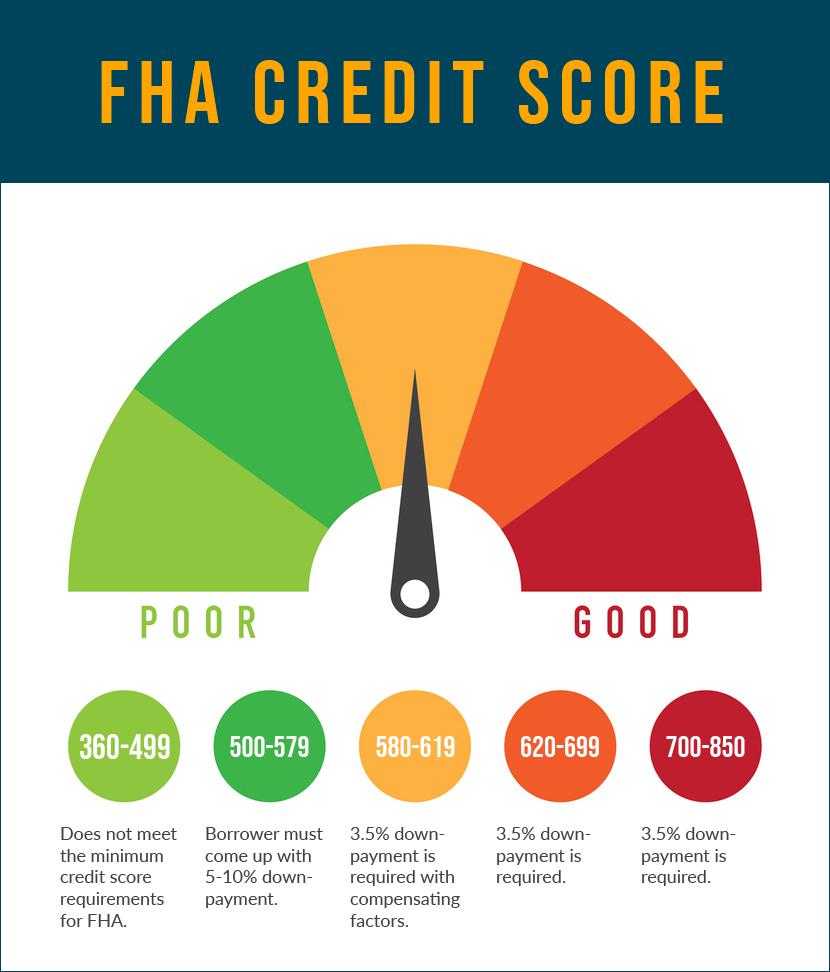
FHA loans are a good deal for many of us with lower credit score. As of 2023, the Federal Housing Administration dropped the minimum credit score requirement for FHA loans to 500. In comparison, the minimum credit score for a conventional loan is 620 and 640 for USDA loans. While it is getting easier for people to get FHA loans, having a 500-credit score can make things difficult. Recent statistics show that you are better off with a higher credit score to qualify for an FHA loan. The minimum credit score rules will vary depending upon the mortgage company you are talking to. Learn more about the current FHA credit score requirements.
FHA Loan Credit Requirement Overview
What are the FHA mortgage requirements for a FHA insured mortgage this year? Direct endorsed FHA loan lenders now will approve more than 96% of people who have a FICO score of 580.
If your score is at least that high, you may qualify for a 3.5% down payment as well. This is one of the most lenient down payment requirements on the market.
Plus, underwriting standards are very forgiving in terms of credit score and debt to income ratios.
Let’s consider what it takes to qualify for FHA loans today.
If you have a 500-credit score, that is the minimum score that will be considered per FHA loan requirements. But know that you will have to put down 10% to get a loan at that FICO score.
Only 2% of FHA loans in the past year have gone to people with 500 to 549 credit scores.
Your best chance for a FHA loan approval with this low of a credit score is to show a clean payment history for the past 180 days and a good sized down payment.
There are many reasons you could have a lower credit score and still qualify for an FHA loan:
- You are using a lot of your available credit. This can lower your score by 50 points in some cases. But as you pay it off, your score will rise.
- You have a lot of credit accounts, or a lot of new credit accounts
- Your credit history is limited
- You had a foreclosure or bankruptcy in the past
FHA mortgage guidelines state that if you have made timely payments on your credit obligations in the recent past, you are a reduced risk. So, if you have a bankruptcy on your credit report from two years ago with sub 600 credit, this will not prevent you from getting an FHA loan.
On the other hand, if your credit report shows you have enough income to support your bills but have a lot of late payments, you are less likely to be approved, even if your score is higher. The best FHA loan lenders care the most about a steady payment history on your obligations in the past 12 to 24 months. This indicates a degree of financial stability that reduces lender exposure.
Where Is the Best Place to Get an FHA Loan?
The best place to get an FHA loan depends on your financial needs and preferences. Many banks, credit unions, and online lenders offer FHA loans. Well-known lenders like Rocket Mortgage, FHA.com, and Wells Fargo specialize in FHA financing. It’s best to compare rates, fees, and customer reviews before choosing a lender. Working with an FHA-approved lender ensures you receive competitive rates and the best guidance for your home-buying process.
How Do I Get an FHA Pre-Approved Mortgage?
To get FHA pre-approved, start by choosing an FHA-approved lender and submitting a pre-approval application. The lender will review your credit score, income, debt-to-income ratio (DTI), and employment history. You’ll also need to provide financial documents like tax returns and bank statements. If approved, you’ll receive a pre-approval letter, which strengthens your offer when shopping for a home. This process typically takes a few days to a few weeks.
What Documents Do I Need for the FHA Loan Checklist?
When applying for an FHA loan, you’ll need:
- Proof of income (pay stubs, W-2s, or tax returns)
- Bank statements (last two months)
- Employment verification
- Credit report & score check
- Debt and asset information
- Property details (if available)
Providing accurate documents ensures faster loan processing and approval. Your lender may request additional documents, depending on your financial situation.
Who Are the Best FHA Lenders for First-Time Home Buyers?
The RefiGuide can help you shop and find the best FHA lenders for first-time home buyers online. The top FHA lenders include Loan Depot, Rocket Mortgage, Chase, and New American Funding. These approved FHA lenders offer low down payment options, flexible credit requirements, and strong customer support. FHA-approved lenders specializing in first-time buyers often provide educational resources and loan programs to help navigate the home-buying process. Comparing FHA mortgage rates and loan terms is essential to finding the best lender for your needs.
What Is Included in FHA Loan Closing Costs?
You can expect to pay for the following closing costs on FHA mortgages. A percentage of these closing costs can be rolled into or financed into the FHA loan:
- Loan origination fee: Percentage of the amount of the loan that the lender charges you
- Discount points to lower rate: 1-point equals 1 percent of the loan amount
- Appraisal fee: What you have to pay to have the home appraised
- Credit report: Charge to pull your credit report
- Tax service: Lender hires a company to ensure there are no liens or taxes owed
- Title insurance: Covers any legal damages if the seller cannot transfer the title legally. This protects the mortgage lender and borrower.
- Attorney fees: What the attorney charges for overseeing the transaction at the title company
- Document fees: FHA lender will charge you to have the many documents ready for closing
- Property taxes: You are charged the remaining yearly property taxes on the home
- Home inspection: Covers cost of having the home inspected
- Survey: The fee to get accurate boundary and property measurements by the surveyor
- FHA Mortgage Insurance Premium: Borrowers that get an FHA loan will be required to pay mortgage insurance every month.
The bottom line is that in some cases, you can reduce your out of pocket expenses when you buy the home by having your closing costs financed or otherwise paid for. Check with your approved FHA lender to see what options you when considering buying a home with FHA financing.
Remember to Account for Mortgage Insurance
FHA loans are great for many situations, but you have to pay for expensive mortgage insurance to get that low interest rate. There are two types of mortgage insurance on FHA mortgages. The first one is an upfront premium of 1.75% of the loan amount. That is $1,750 for a $100,000 loan. That can be rolled into the mortgage.
The other type of FHA mortgage insurance has the annual premium that is paid each month. The amount varies on the loan length and the loan to value or ‘LTV’. For a 30-year FHA loan with a down payment of less than 5%, your annual insurance premium with be .85% of the loan amount. The reality is that the FHA mortgage insurance premium is the reason people can get an FHA loan with only a 3.5% down-payment in 2023.
The FHA Lender Must Be Approved to Issue FHA Loans
Know that FHA does not lend money; it merely insures the loan issued by a lender. So borrowers need to get an FHA loan through a lender approved by the agency. Not all FHA loan lenders offer the same rates. Some have investors who want more security and charge a higher rate, while others are willing to offer a lower rate.
How to Assume an FHA Mortgage
Are FHA Loans Assumable? FHA mortgage loans offer the advantage of being assumable, a feature that can prove beneficial for both buyers and sellers. In essence, an assumable mortgage permits a homebuyer to take over the existing FHA loan along with its terms when purchasing a property.
For prospective buyers, assuming an FHA mortgage holds several advantages, particularly if the current FHA mortgage rate is lower than the prevailing market rates. This can result in substantial savings over the duration of the FHA home loan. Furthermore, the process of assuming an FHA loan often involves less rigorous credit requirements compared to securing a new mortgage.
Sellers can also reap the rewards of the assumable feature. It can enhance the marketability of their property, particularly when interest rates are on the rise. The ability to offer a potential buyer an assumable FHA loan can make the property stand out in a competitive real estate market.
Are All FHA Loans Assumable?
However, it’s crucial to note that not all FHA home loans are assumable. For FHA loans initiated after December 1, 1986, the assumption necessitates approval from the lending institution, and specific criteria must be met. The prospective buyer must also qualify for the assumption by demonstrating their creditworthiness and their capacity to meet the obligations of the FHA loan. It’s essential for all parties involved to have a comprehensive understanding of the terms and payment responsibilities associated with assuming an FHA mortgage before committing to this option. It’s important to be aware that if a homebuyer takes over an FHA loan, they will also be obliged to make monthly payments for FHA mortgage insurance premiums.
Does the Federal Housing Agency Make Loans?
The FHA itself does not provide mortgage financing. Instead, the loan is issued by a bank or another financial institution that is FHA-approved. The FHA guarantees the loan, which reduces the risk for the bank and makes it easier for borrowers to obtain approval. This is why such loans are often referred to as FHA-insured loans.
Borrowers who qualify for an FHA loan must purchase mortgage insurance, with the premium payments directed to the FHA. Read more about FHA and the Consumer Financial Protection Bureau.
How to Qualify for a FHA Loan with No Mortgage History
Do you want to buy a home and have limited credit history, no credit history, or no mortgage history? You are not alone. Many first-time home buyers face significant challenges in buying their first house. Specifically, many lack a long credit history. This makes it more difficult for lenders to determine your risk profile and decide to give you a loan.
Most first-time home buyers have never had a mortgage or have not had one in years. They also may own their car in cash and may use their debit card rather than credit cards. These traits make many new house buyers off the grid when it comes to credit and may make getting a mortgage more challenging.
If you think there is no hope, you are wrong: The FHA loan is available to people buying a home for the first time with little credit or no credit. And, FHA backed mortgages can be had from most mortgage lenders in the US.
FHA Loans and Non-Traditional Credit
First-time home buyers typically possess lower credit scores compared to homeowners, primarily because they have had less time to establish a credit history. Payment history plays a pivotal role in determining one’s FICO score.
However, it’s important to note that the solution is not necessarily obtaining a credit card or taking out a car loan, as these actions can temporarily negatively impact your credit score.
Credit score algorithms tend to view acquiring new credit lines as a drawback. Moreover, the impact on your credit score remains limited until the payment history on the account spans at least 12 months.
A more advisable approach, as recommended by many experts, is to explore mortgage loans tailored for individuals with limited credit histories, such as the FHA loan. Sponsored by the Federal Housing Administration, this program explicitly states on its website that a lack of credit history or limited credit usage should not serve as grounds for rejecting a loan application.
Instead of turning away applicants lacking credit history or prior mortgage experience, FHA loan guidelines necessitate lenders to scrutinize every facet of the loan application.
FHA has the flexibility to consider your rental history as a crucial aspect. If you can demonstrate consistent, on-time rent payments over the last one or two years, provided they are in line with potential mortgage payments, this can serve as a basis for approving a mortgage.
Furthermore, FHA allows lenders to require minimal down payments, with the current minimum being just 3.5%, a highly reasonable option for first-time home buyers. Often, these buyers face challenges in amassing substantial down payments, especially when they lack equity in an existing home.
Additionally, issues related to bad credit loans for first-time home buyers are not insurmountable with FHA, as they permit lenders to accept credit scores as low as 580 with a 3.5% down payment. The program also accommodates higher debt-to-income ratios.
Approval Up to the FHA Mortgage Lender?
FHA home loans are underwritten by private lenders that have been approved to do FHA loan programs. All lenders must follow FHA guidelines, but these rules are not absolute when it comes to credit score. Some lenders may work with a borrower with a 580-credit score, while others only work with borrowers with a higher score. If you have a credit score lower on the scale, it is wise to check with several of the best FHA lenders. If you cannot qualify with one lender, you might be able to with another.
Generally, getting an FHA loan approved with a 500 score will be arduous. You will need to have solid income, 10% down payment, and probably some cash reserves. People with a 580 or higher score only need 3.5% down usually, and no cash reserves are needed.


In addition to an acceptable credit score, you must demonstrate enough income to pay the loan and a reasonable amount of debt. Generally, you should have a front-end ratio of 31% and a back-end ratio of 43% to qualify for an FHA loan program. This means your mortgage debt compared to your gross monthly income should not be a ratio of more than 31%, and your total debt compared to your gross monthly income should not be more than 43%.
However, some of the best FHA loan lenders might allow those ratios to go higher if you have enough income and reserves. Others with higher credit scores may also be able to be approved with higher debt to income ratios.
According to current FHA statistics, there is a big market in the country for loans for people with a limited credit history – up to five million households across the country. So, it is important to not let your lack of credit history discourage you from applying for a mortgage.
How to Qualify for FHA Loans After a Chapter 7 Bankruptcy
Many individuals hold the mistaken belief that obtaining a mortgage after a bankruptcy is a prolonged process spanning seven to ten years. This misconception is far from the truth. In the aftermath of the mortgage crisis, a substantial number of people found themselves declaring bankruptcy. For the housing market to thrive, it’s crucial that the top FHA lenders do approve loans for individuals with recent bankruptcies.
The established standard for securing approval for an FHA loan after a Chapter 7 bankruptcy is a two-year waiting period, and it shortens to just 12 months for Chapter 13. The primary focus here is demonstrating to both FHA and its lending institutions that you’ve maintained a solid payment history over the past 12 to 24 months.
In such cases, a prior bankruptcy need not be an impediment. Furthermore, FHA loans remain a viable option even after a foreclosure. Significantly more individuals faced foreclosures following the mortgage crisis than those who declared bankruptcy. Typically, the waiting period for FHA loans is three years, although some mortgage brokers may have more flexible criteria. It’s advisable to inquire within the lending community to explore your options.
What is the Energy Efficient FHA Mortgage?
The FHA Energy Efficient Mortgage (EEM) is a special FHA loan financing program designed to empower homeowners to make energy-efficient improvements to their properties. This unique FHA loan program allows borrowers to include the cost of energy-efficient upgrades into their FHA insured mortgage.
By doing so, homeowners can finance projects such as solar panels, insulation, or energy-efficient HVAC systems, facilitating the creation of an environmentally friendly and energy-efficient houses. The primary advantage of the FHA energy efficient mortgage is that it enables borrowers to make these improvements with minimal upfront costs.
The cost of the energy-efficient upgrades is rolled into the mortgage, and the increased monthly payments are offset by the anticipated energy savings, making it a financially sensible choice. This innovative FHA loan program aligns with the growing emphasis on sustainable living and allows homeowners to contribute to both a greener environment and long-term cost savings. FHA EEM serves as a practical and accessible avenue for those seeking to enhance their homes while embracing energy efficiency.
What to Expect with FHA Mortgage Programs in 2026
The FHA loan limits were raised by the US Congress for the coming year and will continue to be a popular choice for first time home buyers and people with average credit scores. FHA loan limits should continue to rise with home values and inflation continuing to soar.
- Secure a FHA Mortgage Preapproval
- Check FHA Mortgage Rates Today
- Shop for the Best FHA Loans
- Apply with Trusted FHA Mortgage Lenders
All indications point to FHA mortgage rates falling in 2026 and with the elections coming up you can expect the Federal Reserve will play an important role in affordability for new home buyers and homeowners looking to lower their monthly payments with the best FHA loan rates we have seen in a few years.
Disclosure: RefiGuide.org is an advertising marketplace, not a licensed mortgage lender or broker. Loans are matched with participating NMLS-licensed institutions.
Reviewed by: Bryan Dornan, Lending Expert (25+ years) | Fact Checked ✓
About Bryan Dornan
Bryan Dornan is a financial journalist and mortgage industry veteran with nearly 30 years of experience as a lender, loan officer, mortgage broker, and chief marketing officer. He currently serves as Chief Editor of RefiGuide.org, where he has built one of the most trusted mortgage education platforms in the United States. Bryan has founded multiple mortgage and digital marketing companies throughout his career and remains focused on helping homeowners leverage home equity wisely while making affordable homeownership accessible to everyday Americans. He is a licensed California Real Estate Broker DRE: #01203791. and writes for RealtyTimes, Patch, Buzzfeed, Medium and other national publications. Find him on Twitter, Muckrack, and Linkedin
More articles by Bryan Dornan