



The no-documentation home equity line of credit, AKA, No Doc HELOC has emerged as a crucial financing tool for homeowners with non-traditional income sources in 2026. These specialized loan products allow borrowers to access their home equity without the extensive income verification required by conventional lenders. This comprehensive guide explores how to qualify for a No Doc HELOC and examines the top stated income HELOC programs available, and provides essential insights for self-employed individuals, real estate investors, and others seeking flexible home equity financing.
Key Takeaways on No Doc HELOCs
- “No doc” doesn’t mean no documentation. It means no tax returns or W-2s. Lenders still verify identity, equity, credit, and assets — they just measure income differently.
- Credit and equity carry the file. Expect a 620 minimum, with 680+ opening most programs, alongside 20% to 30% equity remaining after the line closes.
- There are four qualification paths, not one: bank statements, asset depletion, DSCR on rental income, or CPA-prepared profit-and-loss statements. The right one depends on where your money actually shows up.
- Expect to pay one to two points above a documented HELOC. That premium buys flexibility, not a better deal.
- Banks rarely offer these. Non-QM lenders, private lenders, and specialty mortgage companies do — which is why a bank denial says nothing about your eligibility.
How Does the No Doc HELOC Work?

A No Doc HELOC functions similarly to traditional home equity lines of credit but with significantly reduced documentation requirements.
Instead of requiring pay stubs, W-2s, and tax returns, these programs focus on alternative verification methods including credit scores, available home equity, bank statements, and asset reserves.
The term “no doc” is somewhat misleading, as these loans still require documentation—just not traditional income verification paperwork.
These financial products are particularly valuable for self-employed professionals, freelancers, gig economy workers, real estate investors, retirees living on investment income, and individuals with fluctuating or seasonal income. For many of these borrowers, traditional income documentation fails to accurately represent their true financial capacity due to business deductions, variable income streams, or complex financial structures.
How to Qualify for a No Doc HELOC in 2026
Credit Score Requirements
Credit scores remain a critical qualification factor for No Doc HELOCs. Since lenders cannot verify income through traditional methods, they rely heavily on creditworthiness to assess risk. Most lenders require a minimum credit score between 620 and 680, though the exact threshold varies by lender and program. Borrowers with scores above 720 typically receive the most favorable terms, including lower interest rates and higher credit limits.
A strong credit history demonstrates financial responsibility and reduces perceived risk for lenders. Payment history, credit utilization, length of credit history, and recent credit inquiries all factor into approval decisions. Some specialized no doc lenders may approve borrowers with scores below 620, but these applicants face higher interest rates and stricter terms.
Home Equity and Loan-to-Value Requirements
Substantial home equity is essential for No Doc HELOC qualification. Most lenders require borrowers to maintain at least 15 to 30 percent equity after the HELOC is established. This translates to a combined loan-to-value (CLTV) ratio of 70 to 85 percent, meaning borrowers can typically access up to 70 to 85 percent of their home’s appraised value minus any existing mortgage balance.
For example, if your home is valued at $500,000 with a remaining mortgage balance of $200,000, you have $300,000 in equity. With an 80 percent CLTV limit, you could potentially access a HELOC of up to $100,000 ($500,000 × 0.80 – $200,000). Lenders verify home values through professional appraisals, though some programs offer no-appraisal options for borrowers with substantial equity cushions.
Alternative Income Verification Options
While No Doc HELOCs minimize traditional income verification, lenders still need assurance of repayment ability. Several alternative verification methods have become standard in 2026:
- Bank Statement HELOC Programs: Lenders review 12 to 24 months of personal or business bank statements to calculate average monthly deposits. They typically apply a 50 percent expense factor to arrive at qualifying income.
- Asset-Based Qualification: Borrowers with substantial liquid assets can qualify based on savings, investments, or retirement accounts rather than income. Lenders calculate a theoretical income by dividing assets by a specified period. This is a great option with a HELOC for self-employed borrowers.
- DSCR HELOC (Debt Service Coverage Ratio): Real estate investors can qualify based on rental property cash flow rather than personal income. Lenders verify that rental income exceeds debt obligations by a specified ratio.
- Profit and Loss Statements: Self-employed borrowers may provide CPA-prepared P&L statements as an alternative to tax returns, demonstrating business profitability without exposing personal tax strategies.
Reserve Requirements
Most No Doc HELOC programs require borrowers to maintain financial reserves equal to 6 to 12 months of payment obligations. These reserves provide a safety cushion and demonstrate financial stability despite reduced income documentation. Acceptable reserves include checking accounts, savings accounts, money market funds, stocks, bonds, and retirement accounts.
Debt-to-Income Considerations
While No Doc home equity lines of credit reduce income verification requirements, lenders still evaluate debt-to-income (DTI) ratios when possible. Most programs accept DTI ratios up to 43 to 50 percent, though some flexibility exists for borrowers with exceptional credit scores or substantial reserves. DTI calculations include all monthly debt obligations divided by qualifying income. Learn more about today’s HELOC credit score requirements.
Property Type Eligibility
No Doc HELOC programs in 2026 extend beyond primary residences to include various property types. Most lenders approve applications for second homes and vacation properties, recognizing that many borrowers own multiple real estate assets. Investment properties also qualify under many programs, particularly when paired with DSCR (Debt Service Coverage Ratio) qualification methods that analyze rental income rather than personal earnings.
However, property type affects both approval likelihood and loan terms. Primary residences typically receive the most favorable rates and highest loan-to-value ratios, as lenders view them as lower risk. Investment properties may face slightly higher rates and lower LTV limits due to increased default risk. Some lenders restrict certain programs to specific property types, so borrowers should confirm eligibility before applying.
Condominium and townhouse approvals depend on project approval status and homeowners association financial health. Rural properties may require additional scrutiny or appraisal considerations. Multi-unit properties (duplexes, triplexes, fourplexes) often qualify when the borrower occupies one unit, though underwriting becomes more complex with additional rental units.
Interest Rates and Costs for No Doc HELOCs in 2026
No Doc HELOC interest rates in 2026 typically range from 8 to 10 percent APR, approximately 1 to 2 percentage points higher than traditional HELOC rates. This premium reflects the additional risk lenders assume when forgoing traditional income verification. Borrowers with excellent credit scores, substantial equity, and strong reserves often secure rates at the lower end of this spectrum.
Most No Documentation HELOCs feature variable interest rates tied to the prime rate, though some lenders offer fixed-rate options or fixed-rate draw periods. Closing costs typically range from 1 to 5 percent of the credit line amount, including appraisal fees, origination fees, title insurance, and recording costs. Some low-doc programs offer reduced or no closing cost options in exchange for slightly higher interest rates.
Benefits and Risks of No Doc HELOCs
Key Benefits
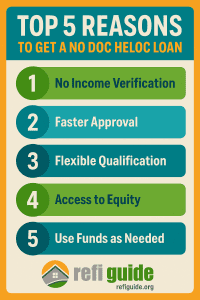
- Accessibility: No Doc HELOCs provide financing options for borrowers excluded from traditional lending due to non-standard income documentation.
- Speed: Reduced documentation requirements often accelerate the application and approval process, with some lenders offering funding in one to two weeks.
- Flexibility: Borrowers can use funds for any purpose including home improvements, debt consolidation, business investments, or emergency expenses.
- Property Versatility: Many programs extend to investment properties and second homes, not just primary residences.
Important Risks
- Higher Costs: Interest rates and fees exceed those of traditional HELOCs, increasing overall borrowing expenses.
- Foreclosure Risk: HELOCs use your home as collateral; missed payments can result in foreclosure proceedings.
- Variable Rates: Most programs feature adjustable rates that can increase over time, potentially raising monthly payments significantly.
- Reserve Requirements: Maintaining significant cash reserves can tie up liquidity that could be deployed elsewhere.
The No Doc HELOC Application Process
Applying for a No Doc HELOC typically involves several key steps. First, borrowers should research available lenders and programs, comparing credit score requirements, loan-to-value limits, interest rates, and fee structures. Multiple lender consultations help identify the best fit for individual circumstances.
Next, gather necessary documentation including proof of identity, property ownership documents, current mortgage statements, bank statements (typically 12 to 24 months), investment account statements, and credit authorization forms. While extensive income documentation is not required, lenders still need verification of assets, equity, and creditworthiness.
The lender will order a property appraisal to establish current market value and determine available equity, though some programs waive this requirement for borrowers with substantial equity cushions. Credit reports are pulled to verify scores and payment history. Underwriters review the complete application package to assess risk and determine approval terms.
Upon approval, borrowers receive a loan estimate detailing interest rates, fees, and terms. After accepting the offer, closing typically occurs within 7 to 14 days for expedited programs. At closing, borrowers sign final documents and receive access to their credit line, usually through checks, a linked bank account, or a dedicated credit card.
State-Specific Considerations
HELOC regulations and availability vary significantly by state, affecting both access and terms for No Doc programs. Texas maintains some of the strictest home equity lending restrictions in the nation, with constitutional provisions limiting combined loan-to-value ratios and restricting cash-out refinancing. Texas borrowers often find HELOCs more restrictive than in other states, with lower LTV limits and specific disclosure requirements.
Florida and Georgia similarly impose unique requirements on home equity lending, though less restrictive than Texas. Some states mandate specific rescission periods, cooling-off periods, or additional consumer protections that can extend closing timelines. California borrowers benefit from extensive consumer protection laws but may face longer processing times due to additional disclosure requirements.
Licensing requirements for lenders also vary by state, affecting which companies can offer No Doc HELOCs in specific jurisdictions. Some specialized lenders operate nationwide, while others focus on particular regions or state markets. Borrowers should verify lender licensing in their state and understand state-specific regulations that may impact their HELOC terms, particularly regarding maximum interest rates, fee caps, and foreclosure procedures.
Case Study: Self-Employed Homeowner Securing a No-Doc Home Equity Line of Credit
Illustrative example based on typical file structures. Figures demonstrate the mechanics; individual results vary by lender, market, and borrower profile.
Background. Michael is a self-employed graphic designer in Sacramento, California. He wanted to access equity to expand his studio — hiring a second designer and upgrading equipment.
His credit score was 740, and his home appraised at $620,000 with a $310,000 first mortgage, leaving 50% equity. On paper, though, he looked unqualified.
Challenge. Michael’s 2025 tax return showed $71,000 in net income after equipment depreciation, home office deductions, software subscriptions, and contractor payments — all legitimate write-offs his CPA correctly claimed. His actual gross receipts ran closer to $185,000. Two banks declined him, not on the property, but because a $71,000 income against his existing mortgage and a car loan produced a debt-to-income ratio near 58%. The tax return was measuring taxable income, not cash flow.
Solution. He worked with a Non-QM lender offering bank statement qualification. Instead of tax returns, the lender reviewed 24 months of business bank statements showing average monthly deposits of $15,400, applied the standard 50% expense factor, and arrived at $7,700 in qualifying monthly income. That recalculated his DTI to roughly 28%.
The approved structure:
| Item | Detail |
|---|---|
| Appraised value | $620,000 |
| Existing first mortgage | $310,000 |
| CLTV cap | 75% |
| Maximum combined debt | $465,000 |
| HELOC approved | $155,000 |
| Documentation | 24 months bank statements, credit report, appraisal — no tax returns |
| Reserves required | 6 months PITI |
| Draw period | 10 years, interest-only minimum |
| Time to close | 24 days |
Outcome: Michael drew $85,000 in the first year — the balance stayed available as a reserve rather than sitting as debt he was paying interest on. His first mortgage was untouched, which mattered: repricing a below-market rate through a cash-out refinance would have cost far more than the HELOC’s rate premium on the new money alone.
The tradeoffs he accepted. A no-doc HELOC prices roughly one to two percentage points above a fully documented line — the cost of skipping tax returns. The rate is variable, so his payment can rise. And the line is secured by his home, meaning a business downturn that stops payments puts the house at risk, not just his credit.
What made the file work wasn’t the no-doc program itself. It was the 50% equity position, the 740 score, and 24 months of consistent deposits. Borrowers with thin equity or irregular deposit history won’t replicate this outcome regardless of documentation type.
Important Points on No Doc HELOCs
No Doc HELOCs represent an important financing option for homeowners with non-traditional income sources in 2026. While these programs offer accessibility and flexibility unavailable through conventional lending, they require careful consideration of higher costs and risks. Borrowers with strong credit scores, substantial home equity, and adequate reserves can successfully leverage these products to access needed funds while preserving their primary mortgage terms. Remember when it comes to equity requirements, 20–30% is the mainstream requirement, 40% is the below-620 exception.
The key to successful No Doc HELOC qualification lies in understanding program requirements, selecting appropriate lenders, and maintaining strong financial fundamentals including excellent credit, significant equity, and adequate reserves. By carefully evaluating available options and working with specialized lenders who understand non-traditional lending, borrowers can secure competitive terms that align with their financial goals and circumstances.
The RefiGuide can help you find lenders that offer the top no-doc HELOCs in 2026. There are still a few companies that require no appraisal, funding in 7 days, and a 620+ credit score and that’s very ideal for self-employed borrowers. Some lenders require bank statements or DSCR for income, suiting investors. Compare terms for flexibility and cost from licensed no doc HELOC lenders.
FAQ for No Doc HELOC Loans
What Is the Minimum Credit Score for a No Doc HELOC?
Most no-doc HELOC lenders set their floor at 620, but where you land above it matters more than clearing it. At 620 to 679, expect fewer participating lenders, tighter CLTV caps, and stricter reserve requirements. 680 to 699 opens most Non-QM programs on standard terms. 700 and above unlocks the best pricing and the highest credit lines. Below 620, options narrow to hard money and private lenders, which typically require 40% or more equity in exchange for looser credit standards. Strong equity and documented reserves can offset a weaker score, but only so far. Borrowers with lower scores may still qualify but will likely face higher interest rates and stricter loan terms. There are hard money lenders that offer the best no doc HELOC programs and stated income home equity loans to borrowers that have at least 40% equity with no minimum credit score requirements.
Who Offers a No Doc HELOC?
No-doc HELOCs are offered primarily by Non-QM lenders, private lenders, and specialty mortgage companies that focus on alternative documentation loans. Traditional banks rarely provide them. These lenders often accept bank statements, assets, or rental income in place of tax returns. The RefiGuide can help you shop no doc HELOC lenders and mortgage brokers that have experience with Non-QM home equity line of credit programs.
Who are the 5 top no doc HELOC lenders in 2026?
Some of the most active lenders offering stated-income or reduced-doc HELOC options include Truss Financial, known for no tax-return, bank-statement, and stated-income HELOC programs with streamlined documentation; Griffin Funding, which offers alternative documentation HELOCs for self-employed borrowers; LBC Mortgage, with no-tax-return or profit-and-loss review options; West Capital Lending, offering bank-statement HELOCs for borrowers with non-traditional income; and DeepHaven Mortgage, with its Equity Advantage program allowing bank statements in lieu of tax returns.
What is a No Doc Home Equity Loan?
A No doc home equity loan is a type of 2nd mortgage that requires minimal documentation for income or asset verification. These no doc home equity loans are often targeted at self-employed homeowners or those with unconventional income sources who find it challenging to meet traditional lending documentation requirements. The RefiGuide will help you learn more about these modern state income loans so you can assess whether or not its a good fit for you.
What Is a No Income Verification Home Equity Line of Credit?
No Doc HELOC vs. Bank Statement HELOC: What’s the Difference?
A bank statement HELOC is one type of no-doc HELOC — not a separate product. “No doc” is the umbrella term for any home equity line that skips tax returns and W-2s. The bank statement version is the most common path within it, qualifying you on 12 to 24 months of deposits with a 50% expense factor applied. Other no-doc routes include asset depletion, DSCR for rentals, and CPA-prepared P&L statements. The choice depends on where your money shows up — deposits, assets, or rent. See our bank statement HELOC guide.
Can You Get a Credit Line Increase with No Income?
It can be difficult to get a credit line increase with no income, as most lenders require proof of ability to repay. However, if you have a strong credit history, significant assets, or low existing debt, some lenders may approve an increase. Contact your HELOC lender to inquire about their specific policies.
Can you get a HELOC without a job?
Yes, you can get a HELOC without a traditional job if you qualify through alternative income methods such as assets, retirement income, rental income, or bank statements. Lenders still require proof of repayment ability, even if you do not have employment income. Having strong equity, high credit scores, and significant reserves improves approval odds. Traditional HELOCs, however, will not approve borrowers without verifiable income.
Can I use unemployment as proof of income?
No, unemployment benefits generally cannot be used as qualifying income because they are temporary and not considered stable. Mortgage and HELOC lenders require income that is likely to continue for at least three years. While unemployment may support your bank balance, it does not count toward repayment ability. Borrowers must use employment income, assets, rental income, or alternative documentation depending on the loan type. Learn more about what disqualifies you for a home equity loan.
Disclosure: RefiGuide.org is an advertising marketplace, not a licensed mortgage lender or broker. No doc HELOC loans are matched with participating NMLS-licensed institutions.
Reviewed by: Bryan Dornan, Lending Expert (25+ years) | Fact Checked ✓
References
- Bankrate. (2026, August 1). Current HELOC rates in August 2026.
- ConsumerAffairs. (2025, May 17). Consumer-Affairs on No doc HELOCs
About Bryan Dornan
Bryan Dornan is a financial journalist and mortgage industry veteran with nearly 30 years of experience as a lender, loan officer, mortgage broker, and chief marketing officer. He currently serves as Chief Editor of RefiGuide.org, where he has built one of the most trusted mortgage education platforms in the United States. Bryan has founded multiple mortgage and digital marketing companies throughout his career and remains focused on helping homeowners leverage home equity wisely while making affordable homeownership accessible to everyday Americans. He is a licensed California Real Estate Broker DRE: #01203791. and writes for RealtyTimes, Patch, Buzzfeed, Medium and other national publications. Find him on Twitter, Muckrack, and Linkedin
More articles by Bryan Dornan