


Florida homeowners hold substantial tappable equity, making a home equity line of credit one of the most cost-effective ways to access cash without disturbing a low-rate first mortgage. And the equity picture keeps improving: Florida’s statewide median for existing single-family homes reached an all-time high of $432,000 in June 2026, up 4.9% year over year, according to Florida Realtors, the tenth consecutive month of year-over-year gains, with sales up 9.3% and inventory tightening to a 4.5-month supply, the lowest in a year.
The condo market tells a different story. Condo-townhouse inventory sits at 8.1 months with the median up just 1.7% to $305,000, reflecting association assessments, insurance costs, and post-Surfside structural reserve requirements. This split matters for HELOC borrowers: Florida condo owners face tighter LTV caps, association questionnaires, and slower approvals than single-family owners, and softer condo values compress available equity further. Single-family owners in Tampa, Orlando, and Jacksonville are in a materially stronger borrowing position than condo owners in Miami-Dade or Broward.
On pricing, the national average HELOC rate is 7.28% as of September 23, 2026 (Bankrate’s survey of the nation’s largest home equity lenders) — up 17 basis points in a single week, the largest jump of the year. That increase arrived one week after the Federal Reserve raised its benchmark a quarter point, moving the target range to 3.75%–4.00% and pushing prime to 7.00% after eight months at 6.75%.
The cheap-equity window has closed. Rates reached a three-year low around 7.31% in February and drifted for most of the year, but September’s hike ended the stability — and because HELOCs reprice directly with prime, every variable line in Florida moved with it. Markets had priced two quarter-point increases before year-end; the first has now landed.
Florida credit unions still price meaningfully below the national average, and that margin matters more than ever now that the index itself is rising. Prime moves for everyone — your margin over prime is the part you negotiate, and it’s fixed for the life of the line. A borrower who secures prime minus 0.50% instead of prime plus 0.50% saves a full percentage point permanently, regardless of what the Fed does next. On a $100,000 line, that’s roughly $1,000 a year in perpetuity.
Shop for the Best HELOC Rates from Florida Lenders Today

The RefiGuide can connect you with competitive lenders offering the best HELOC rates in Florida, with flexible terms and reduced closing costs.
HELOCs provide revolving credit against your home’s equity, typically up to 80%–90% combined loan-to-value, with a 5-to-10-year draw period followed by a repayment phase. Florida HELOC rates are tied to the Wall Street Journal Prime Rate, currently 7.00%, plus or minus a lender margin.
Prime rose to 7.00% in September 2026 after the Federal Reserve raised its benchmark a quarter point, moving the target range to 3.75%–4.00% and ending eight months of stability at 6.75%. Because HELOCs reprice directly with prime, every variable line in Florida moved with it — Bankrate’s national average jumped 17 basis points in a single week, its largest increase of the year.
Your margin is the part you control. Prime moves for everyone, but the margin your lender assigns at closing is fixed for the life of the line. To find yours, subtract 7.00% from your current rate. A borrower at prime minus 0.50% pays 6.50% today; one at prime plus 1.00% pays 8.00% — and that gap persists permanently regardless of what the Fed does next.
Know your caps. Most agreements include a periodic cap, commonly 2% annually, limiting how fast your rate can climb in any twelve-month stretch. A lifetime cap, commonly 18%, sets the absolute ceiling. Those provisions mattered little when prime was flat. They matter now — check your agreement for both before you draw, and ask any lender you’re shopping what their caps are.
Florida-specific factors affect eligibility more than in most states:
- Flood zone designation — properties in Special Flood Hazard Areas require flood insurance, and some lenders apply additional LTV restrictions
- Condo underwriting — association financials, reserve studies, and structural integrity documentation are frequently required, and maximum LTV is often 10 to 15 points below single-family limits
- Insurance premiums — Florida’s elevated property insurance costs raise debt-to-income calculations and can affect qualification independent of the HELOC itself
- Wind mitigation — some lenders require current inspection reports on coastal properties
FAQs for Florida HELOCs:
Does Florida’s Homestead Exemption Affect Your Ability to Get a HELOC?
Florida’s Homestead Exemption — which reduces assessed value by up to $50,000 and caps annual assessment increases at 3% (Save Our Homes) — does not prevent you from obtaining a HELOC financing, but it is specifically limited to your primary residence. Since this home equity line of credit also require owner-occupancy for the best rates and highest LTV limits (up to 90% for primary homes), the exemption and HELOC eligibility naturally align for Florida homeowners. Investment properties and second homes lose both the exemption and access to preferred HELOC terms — expect lower LTVs (75%) and higher rates on non-homesteaded Florida properties.
Is HELOC Interest Tax Deductible for Florida Homeowners?
Florida homeowners can potentially deduct HELOC interest on their federal return, but only when funds are used to “buy, build, or substantially improve” the home securing the loan — per IRS Publication 936 rules that remain in effect for 2026. Using a Florida HELOC for renovations, a room addition, or hurricane hardening qualifies; using it for debt consolidation, vacations, or investment properties does not qualify. Florida has no state income tax, so the deduction applies only federally. Always keep itemized receipts and contractor invoices to substantiate the improvement use.
Can You Get a HELOC on a Florida Condo?
Yes — but Florida condos face stricter HELOC underwriting than single-family homes due to shared liability risk, HOA financial health requirements, and coastal exposure. Most Florida HELOC lenders cap condo LTV at 75%–80%, compared to 85%–90% for detached homes. Lenders typically require the condo project to be FHA-warrantable or conventionally approved — meaning no more than 15% of units delinquent on HOA dues and no active litigation against the association. Post-Surfside legislation has added reserve and inspection requirements that affect some older Florida condo buildings, so lender acceptance varies significantly by project.
What Are Typical Closing Costs on a Florida Home Equity Loan?
Florida home equity loan closing costs typically range from $300–$2,000 depending on lender and loan size, covering appraisal or AVM fees, title search, recording fees, and origination charges. Florida’s intangible tax of 0.2% of the loan amount applies to new notes — on a $100,000 home equity loan, that adds $200. Several Florida credit unions — including Space Coast Credit Union and Floridacentral — waive most closing costs as a membership benefit. However, if you pay off the line within 24–36 months of opening, many lenders require you to reimburse their closing costs, so review the recapture terms carefully before signing. Learn more about what questions to ask when applying for a home equity loan in 2026.
Do Florida HELOC Lenders Require Flood Insurance?
Yes — if your Florida property is located in a FEMA-designated Special Flood Hazard Area (SFHA), also called a high-risk flood zone (Zone AE, VE, or similar), your HELOC lender is federally required to mandate flood insurance before approving the loan. Properties in moderate or low-risk zones (Zone X) are not federally required to carry flood insurance, but some Florida lenders may still require it given the state’s coastal and weather exposure. Flood insurance premiums — often $1,500–$4,000+ annually in high-risk zones — affect your debt-to-income ratio and overall HELOC qualification calculations.
3 Case Studies of Florida Homeowners Locking in Low HELOC Rates
Drawn from 2025 trends in MIDFLORIDA and CBS News reports on HELOC surges, these anonymized stories highlight real strategies amid Florida’s home equity boom.
Case 1: Miami Retiree Funds Hurricane Prep (Carlos, 67)
Carlos, a retired accountant in Miami-Dade with $250,000 equity in his 1990s condo, faced 2025’s 15% insurance hike post-Hurricane season. His 740 FICO and $80,000 pension qualified him for Tropical FCU’s 6.25% intro HELOC, drawing $60,000 in 28 days for storm shutters and a generator. Payments: $312/month interest-only, saving $2,400 versus 9% personal loans. By October, his score stayed at 735, and the upgrades boosted resale value 8%. “Tropical’s local rate beat nationals—prep paid off before Milton,” Carlos shared in a MIDFLORIDA-inspired story on equity timing. Lesson: Credit unions excel for coastal risks.
Case 2: Orlando Investor Diversifies (Lena, 42)
Orlando realtor Lena used $180,000 equity from her $350,000 townhome to fund a $90,000 down payment on a rental amid 7% appreciation. Self-employed with variable income, her 710 FICO secured Third Federal’s 7.25% rate in 25 days, with no fees and 85% LTV. Drawing $90,000 (50% utilization) kept payments at $544/month, covered by rental yields. Score rebounded to 720 by Q4 via on-time history. “Third’s guarantee locked the lowest—scaling in FL’s hot market,” she echoed in a CBS HELOC feature on September declines. Key: Guarantees ensure competitive edges and competitive home equity loan rates in Florida.
Case 3: Tampa Family Consolidates Debt (Jamal, 38)
Tampa dad Jamal tackled $40,000 in 18% credit card debt from family expansions, leveraging $200,000 equity in his suburban home. With a 680 FICO and $95,000 salary, Floridacentral’s 7.25% HELOC closed in 30 days, drawing $40,000 to slash DTI from 45% to 28%. Monthly cost: $242, saving $3,200 yearly. His score climbed 25 points to 705 by October. “Floridacentral’s community rates turned crisis into control,” Jamal noted in a National Debt Relief blog on 2025 HELOCs for debt relief. Insight: Low minimums aid moderate-equity owners. Learn more about improving curb appeal for increased home equity from Marney’s Tidbits blog.
Check FL HELOC Rates in Tampa, Jacksonville, Orlando, Miami and Palm Beach from Top Florida Lenders
Check today’s home equity line rates from banks and lenders in your city. These tales, mirroring Florida’s 18% HELOC growth per Bankrate, show disciplined use yields quick ROI. Compare the best HELOC lenders nationwide.
Top 10 Mortgage Lenders or Banks Headquartered in Florida
Florida’s lending landscape is unusually credit-union heavy, which is why the state’s most competitive HELOC pricing tends to come from member-owned institutions rather than national banks. The list below ranks Florida-headquartered lenders by total assets, drawn from NCUA and FDIC call report filings. The RefiGuide ranks the best HELOC lenders in Florida based on the top 10 by assets, Florida HELOC volume, and satisfaction:
| # | Institution | Headquarters | Total Assets | Members / Reach | HELOC Relevance |
|---|---|---|---|---|---|
| 1 | Suncoast Credit Union | Tampa | $17.5B | 1.3 million members, 79 branches | Florida’s largest credit union. Open to anyone who lives, works, attends school, or worships in the 39 counties served. |
| 2 | VyStar Credit Union | Jacksonville | $14.7B | 997,000 members, 54 locations | Dominant in North and Central Florida; strongest branch network in the Jacksonville corridor. |
| 3 | Space Coast Credit Union | Melbourne | $9.2B | 685,000+ members, 68 branches | Third largest in the state. Serves 35 counties spanning both coasts. |
| 4 | MIDFLORIDA Credit Union | Lakeland | $8B+ | 472,000+ members, 63 locations | Gulf Coast through Central Florida coverage. |
| 5 | FAIRWINDS Credit Union | Orlando | Verify | Verify | Fifth largest Florida credit union per NCUA rankings; Central Florida focus. |
| 6 | Grow Financial FCU | Tampa | Verify | Verify | Tampa Bay regional lender. |
| 7 | Campus USA Credit Union | Gainesville area | Verify | Verify | North Central Florida. |
| 8 | Achieva Credit Union | Dunedin | Verify | Verify | Tampa Bay and Southwest Florida. |
| 9 | Eglin Federal Credit Union | Fort Walton Beach | Verify | Verify | Northwest Florida Panhandle leader. |
| 10 | Seacoast National Bank | Stuart | Verify | Verify | One of the largest Florida-headquartered community banks; Treasure Coast and East Coast markets. |
Asset figures from NCUA and FDIC call report filings. Florida has 190 active financial institutions — 83 banks and 107 credit unions — with combined assets of roughly $470 billion as of August 31, 2026. Membership eligibility varies; most Florida credit unions admit members based on residence, employment, or affiliation. Verify current figures and HELOC terms directly with each institution. Updated September, 2026.
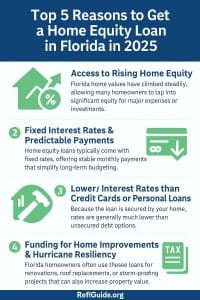
Why You Should Get a Home Equity Loan in Florida in 2026
In 2026, Florida homeowners are uniquely positioned to leverage their property’s growing value through a home equity loan. Here are the top five reasons why this strategy makes sense today.
1. Unlock Record High Home Equity: Florida’s housing market remains strong, with significant appreciation in areas like Tampa, Orlando, and Naples. That equity can be transformed into cash for large purchases, home upgrades, or investment opportunities.
2. Fixed Rates and Predictable Payments: A home equity loan offers fixed interest rates and structured payments, providing long-term stability even as market rates fluctuate. This predictability simplifies financial planning for Florida families facing rising costs of living.
3. Lower Interest than Credit Cards or Personal Loans: Because your home secures the loan, interest rates are substantially lower than those for unsecured debt. This makes a home equity loan an ideal tool for consolidating high-interest credit cards or personal loans into one manageable monthly payment.
4. Financing Home Improvements & Hurricane Upgrades: Many Florida homeowners use home equity loans to fund projects that enhance safety, such as installing impact-resistant windows, replacing roofs, or remodeling kitchens. These upgrades can increase comfort, resilience, and property value.
5. Possible Tax Benefits: When proceeds are used for qualifying home improvements, the loan interest may be tax-deductible under IRS guidelines, further improving the loan’s cost-effectiveness.
In short, a home equity loan in Florida can be a financially strategic move in 2026—offering access to built-up value, predictable payments, and the ability to reinvest in your property. Homeowners should, however, compare Florida HELOC lenders and ensure the repayment terms align with their long-term financial goals.
Florida’s HELOC Opportunity Has Changed Shape
The window closed. In September 2026 the Federal Reserve raised its benchmark a quarter point, moving the target range to 3.75%–4.00% and lifting prime from 6.75% to 7.00% after eight months of stability. Because HELOCs reprice directly with prime, every variable line in Florida moved with it — the national average jumped 17 basis points in a single week, to 7.28%, its largest increase of the year.
The advice hasn’t changed, but the reasoning has. In July, waiting for rate cuts was a bet against the Fed’s signals. Now it’s a bet against a move that already happened — and markets had priced two increases before year-end, with only the first delivered.
What still works: margin, not timing. Prime moves for everyone. The margin your lender assigns is fixed for the life of the line, and Florida credit unions remain the place to find the best ones. Tropical Financial Credit Union prices at prime minus 1%, which at today’s 7.00% prime means 6.00% — roughly 1.28 points below the national average, or about $1,280 a year on a $100,000 line, and that advantage persists no matter where prime goes next.
The equity is still there. Florida’s median single-family price hit an all-time high of $432,000 in June 2026, up 4.9% year over year. What’s gone is the cheap pricing — which makes lender selection matter more now than it did three months ago, not less.
Disclosure: RefiGuide.org is an advertising marketplace, not a licensed mortgage lender or broker. Loans are matched with participating NMLS-licensed institutions.
Sources:
- Mortgage Professional America. (2026, July). Florida sales extend winning streak as buyers adapt to 6.5% rates.
- Florida Realtors. (2026, July 17). Florida home sales gain momentum, extend growth streak to 10 months.
- Bankrate. (2026, July 22). Current HELOC rates in July 2026.
- Moving to Florida Guide. (2026, July). The Florida real estate market outlook for latter 2026.
- Federal Reserve. (2026, June 17). FOMC statement and Summary of Economic Projections.
Reviewed by: Bryan Dornan, Lending Expert (25+ years) | Fact Checked ✓
About Bryan Dornan
Bryan Dornan is a financial journalist and mortgage industry veteran with nearly 30 years of experience as a lender, loan officer, mortgage broker, and chief marketing officer. He currently serves as Chief Editor of RefiGuide.org, where he has built one of the most trusted mortgage education platforms in the United States. Bryan has founded multiple mortgage and digital marketing companies throughout his career and remains focused on helping homeowners leverage home equity wisely while making affordable homeownership accessible to everyday Americans. He is a licensed California Real Estate Broker DRE: #01203791. and writes for RealtyTimes, Patch, Buzzfeed, Medium and other national publications. Find him on Twitter, Muckrack, and Linkedin
More articles by Bryan Dornan