



Today homeowners looking for cash out have a choice to refinance or take out a home equity loan in an effort to leverage the equity in their home for money. Let’s explore the pros and cons of a cash out refinance versus home equity loans. In most cases, when the interest rate trend is upward, the market for home equity loans increases. When considering refinancing to receive cash you should make sure it makes sense to increase the interest rate and monthly payment.
Pros and Cons: Cash-Out Refinance vs Home Equity Loan
| Factor | Cash-Out Refinance | Home Equity Loan |
|---|---|---|
| How it works | Replaces your existing first mortgage with a new, larger loan · you receive the difference in cash at closing | Adds a second mortgage on top of your existing first mortgage · first mortgage stays untouched |
| Current avg rate | 6.70% (30-yr fixed) · 5.67% (15-yr fixed) — Bankrate, March 2026 | 7.85% (5-yr) · 7.99% (10-yr) · 7.97% (15-yr) — Bankrate, March 2026 |
| Rate type | Fixed for the life of the new loan | Fixed for the life of the loan |
| Rate advantage | ✅ Typically 1%–2% lower than home equity loan rates | ❌ Higher rate — premium for keeping your first mortgage intact |
| Best rate scenario | ✅ Best if your current mortgage rate is above 6.22% — you can refinance to a lower rate AND get cash | ✅ Best if your current mortgage rate is below 6% — keeps your low first mortgage intact |
| Monthly payments | One payment — replaces your existing mortgage payment · may be higher or lower depending on your new rate and balance | Two payments — your existing mortgage payment PLUS a new fixed second mortgage payment |
| Closing costs | 2%–3% of new loan amount · typically $6,000–$12,000 on a $300K loan | 2%–5% of loan amount · typically $2,000–$7,500 on a $100K–$150K loan |
| ✅ Pro — rate | Lower interest rate than a home equity loan in most cases | Preserves your existing low first mortgage rate |
| ✅ Pro — simplicity | One loan, one payment, one lender | Does not disturb your current mortgage terms |
| ✅ Pro — loan size | Can access more cash — replaces entire mortgage balance | Smaller second loan — only borrows what you need |
| ✅ Pro — term | Can reset to a new 15- or 30-year term to lower payments | Shorter fixed terms (5–15 yr) — pay off equity debt faster |
| ❌ Con — rate risk | Replaces your entire mortgage at today’s rate — bad if you have a rate below 5% | Second mortgage rate is higher than a cash-out refi rate |
| ❌ Con — cost | Higher total closing costs — based on full new loan amount | Two separate loan payments every month |
| ❌ Con — timeline | Longer process — 30–45 days typical · resets your mortgage payoff clock | Usually 2%–5% closing costs on the second loan amount |
| ❌ Con — complexity | Requalification required on full new loan amount — income, credit, appraisal | Second lender is subordinate — higher risk = slightly higher rate |
| Tax deductibility | Interest deductible only if cash used to buy, build, or substantially improve the home (IRS §163(h)) | Interest deductible only if cash used to buy, build, or substantially improve the home (IRS §163(h)) |
| Choose this if… | Your current mortgage rate is above 6% · you want one payment · you need a large amount of cash | Your current mortgage rate is below 6% · you want to protect your first mortgage · you need a specific lump sum |
Rates: Bankrate national averages, March 20–21, 2026. Cash-out refi rates assume 700+ FICO, 80% LTV, primary residence, 30-year fixed. Home equity loan rates assume $30K loan, 700 FICO, 80% CLTV. Tax rules per IRS §163(h) as amended by the One Big Beautiful Budget Act (PL 119-21, July 4, 2025). Consult a tax advisor for your specific situation. Updated March 2026.
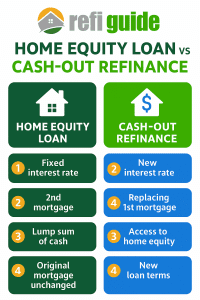
Sometimes, keeping your current mortgage and adding an equity loan is the prudent choice. Let’s examine the difference between cash out refinance and home equity loan and weigh the pros and cons for each type of loan.
Exploring cash out refinancing provides an opportunity to secure new mortgage rates and terms, along with the potential for a lump sum of cash.
However, for those content with their current mortgage, home equity loans offer a potentially more cost-effective avenue for obtaining cash, because you can keep your existing low interest mortgage.
Your home is not just your castle. It can be a cash source for home renovations, repairs, college tuition, or an emergency fund.
The equity you have built up can be tapped through a mortgage refinance or a home equity loan.
What’s the difference and which is better for you?
These cash-out refinance and home equity terms are often discussed but it’s important to determine which type is loan is best for your situation.
Which Is Best, a Home Equity Loan or Cash Out Refinancing?
Home equity loans and a cash-out refinance share a common goal in that they provide a means to secure funds for significant expenses like home remodeling, medical expenses, education costs, or consolidating revolving debt.
Despite this shared purpose, they each bring distinct advantages and drawbacks, catering to different situations. A cash out refinance pays off the old loan and offers additional money that comes back with a new one with a higher loan amount.
A home equity loan gives you equity with a different mortgage loan, known as a second mortgage.
Cash out refinances are well-suited for individuals in a market when interest rates are low.
Today the mortgage rates are the highest they have been in 23 years, so unless the borrower has a high interest rate on their first mortgage above 6%, its unlikely that a cash out refinance makes sense.
In an era of low interest, if a borrower needed of a substantial amount of funds for a specific purpose, such as significant home renovations, then cash out refinancing would be a wise choice.
In a time like this with high mortgage rates, it makes sense in most cases, to take out a home equity loan even if the interest rate is higher, because you can leave your low interest mortgage in tact.
They are more appropriate for those seeking access to a financial reserve over an extended duration rather than in one lump sum. The refinance cash out vs home equity loans debate is an important consideration, so getting advice from a trusted financial professional is highly recommended.
What Is the Difference Between a Home Equity Loan and a Cash Out Refinance in 2026?
What sets a home equity loan apart from a cash-out mortgage is their position on title. Cash out refinances replace your original mortgage with a new first mortgage, while home equity loans are considered a 2nd mortgage that entail an additional payment.
Typically, cash out refinance rates are more favorable compared to home equity loan rates. In most cases, the rates on a cash out refinance will be 1% to 2% points lower than the rate on an equity loan.
We recommend adding your current mortgage payment to the proposed home equity loan payment. Compare those combined payments to the prosed cash-out refinance payment. This will reveal the best solutions with the lowest monthly payment.
Refinancing Your Current Mortgage
There are two ways to do your mortgage refinance: rate and term refinance and cash out:
- A rate and term refi does not add to your loan amount, and you do not receive cashback. There are closing costs and fees, as with any new loan.
- The cash-out refinance loan gives you some of your equity as cash. You come from the closing table with a new, higher loan and a certified check with some of your equity.
Expect closing costs to be 2-3 percent of your new loan amount.
On a refinance, you may need to pay taxes depending on your state and community. It is wise to live in the home for at least another year if you refinance your mortgage.
Financial experts advise going with a rate and term refinance if you can recoup your costs in about 18 months with the lower interest rate.
Home equity loans are second mortgages with lower rates than unsecured loans because your property backs them. That is the catch: If you do not pay the second mortgage, the lender can foreclose your home.
There are two types of home equity finance options: a regular home equity loan with a lump sum cash payment and a home equity line of credit.
A HELOC is similar to a credit card that is connected to the equity in your property. During the draw period after you receive the HELOC, you may borrow as much or as little as you wish, for the most part. Some loans require minimum withdrawals. Getting a low credit home equity loan may be more difficult to qualify for than refinancing.


You may need to pay a fee every time you pull out cash or a fee if you do not use the credit line during the draw period. During the five to 10 year draw period, you only are paying interest on what you borrow. When the draw period is over, your credit line is gone. You begin paying back the loan principal plus interest. Compare HELOCs and home equity loans. Both HELOCs and home equity loans are tax deductible in most cases.
A home equity loan and HELOC are often referred to as second mortgages or junior liens. You already have your first mortgage, and then you take out another loan against the equity built up in the home. The home equity loan is subordinate to the first mortgage. If you default, the second lender is behind the first lender to collect proceeds from the foreclosure.
Second mortgage interest rates are usually higher than cash out refinance rates because of their higher risk. Home equity loans usually have a fixed rate, but some are adjustable. HELOCs typically have flexible interest rates based on the Prime Rate or LIBOR Rate.
In contrast to unsecured loans such as credit cards and personal loans, home equity mortgages typically boast lower interest rates, ensuring more economical borrowing. Additionally, the interest rates on home equity loans remain fixed throughout the loan’s lifespan, simplifying monthly budgeting.
For those with ample equity, securing a larger sum is often more achievable with a home equity loan compared to similar mortgage options.
What Are the Drawbacks of a Home Equity Loan?
While home equity loans offer numerous benefits, it’s essential to be mindful of potential drawbacks. One significant concern is the risk of foreclosure. By securing a home equity loan, your home serves as collateral, implying that failure to meet payments could lead to the loss of your property.
Do you Need an Appraisal for a Home Equity Loan?
In most cases, taking out a home equity loan necessitates an appraisal. However, in some rare instances, a broker offers equity loans and HELOCs with a statistical appraisal which is quick and less expensive.
Most lenders require a full appraisal as a safeguard against the potential risk of default on the equity loan or cash-out refinance. In the event that a borrower is unable to sustain monthly payments in the long term, the lender seeks assurance that it can recover the loan’s cost through the appraisal mechanism. Learn more about getting a HELOC or home equity loan without an appraisal.
Refinance or Home Equity Loan?
You bought your home 10 years ago and the rates were 5% on a 30-year fixed mortgage. In 2026, you could get a new mortgage at 3.5%. Saving 1.5 points on your new mortgage can cut hundreds of dollars per month from your payment. It also will reduce your interest payments by thousands over the loan term. Back then, a cash out mortgage refinance could be your best option.
Today, in 2026, the 30-year rates are in the 6% range, so leaving your 3.5% alone and pulling out cash with an equity loan would be wise. In most cases, if you already have a first mortgage in the 3-4% range, but want cash to pay for a new kitchen or deck, a home equity loan could be a perfect choice.
You may opt for a home equity loan with a fixed rate if you like to know precisely your rate and when the loan will be paid in full. If you want a lower initial rate and are comfortable with the rate adjusting in the future, an equity line could be for you. The RefiGuide will connect you with credible lenders that can help you choose between a home equity loan vs refinance with cash out.
Top 5 Reasons to Get a Home Equity Loan or Cash-Out Refinance in 2026

As a homeowner, your property is more than a place to live—it’s a valuable financial asset.
With rising home values and increased equity across the country, 2026 presents an excellent opportunity to explore financial solutions like a home equity loan vs refinance with cash out.
These tools allow homeowners to access their equity for a variety of purposes, from managing debt to funding life’s biggest expenses.
At RefiGuide.org, we’re here to help you make informed decisions about leveraging your home’s equity. Here are the top five reasons to consider a home equity loan or cash-out refinance this year.
1. Consolidate High-Interest Debt
If you’re carrying high-interest debt, such as credit card balances or personal loans, a home equity loan or cash-out refinance can be a game-changer. By using your home’s equity to pay off these debts, you can consolidate multiple payments into a single monthly obligation with a significantly lower interest rate.
- Why It Matters in 2026: With credit card rates expected to remain high, refinancing debt into a lower-rate home loan can save thousands over time. A cash-out refinance offers a fresh start by replacing your existing mortgage with a new loan that includes funds for debt repayment.
By managing your debt strategically, you’ll improve your financial stability while reducing monthly expenses.
2. Fund Home Improvements and Renovations
Investing in your home is one of the most effective ways to increase its value and improve your quality of life. Home equity loans and cash-out refinancing provide homeowners with the funds needed for upgrades, from remodeling a kitchen to building an energy-efficient addition.
- Why It Matters in 2026: Rising home values mean many homeowners have built substantial equity. Using that equity to enhance your property can provide long-term benefits, including increased resale value and reduced utility costs.
Additionally, certain renovations may qualify for tax benefits, as interest on loans used for home improvements may be tax-deductible. Always consult a tax professional to understand your eligibility.
3. Cover Major Life Expenses
Life’s significant expenses—such as college tuition, medical bills, or weddings—can place a strain on any budget. Instead of resorting to high-interest personal loans, homeowners can use a home equity loan or cash-out refinance to access the funds they need.
- Why It Matters in 2026: As education and healthcare costs continue to rise, homeowners can turn to their home’s equity as a financial safety net. A home equity loan offers a lump sum with predictable monthly payments, while a cash-out refinance allows for larger amounts with the added benefit of potentially securing a lower interest rate on your mortgage.
This approach helps you cover essential costs without relying on expensive short-term credit solutions.
4. Take Advantage of Favorable Interest Rates
Although interest rates fluctuate, 2026 could bring opportunities for refinancing at competitive rates. A cash-out refinance allows you to replace your existing mortgage with a new loan, often at a lower rate, while also providing access to cash for other needs.
- Why It Matters in 2026: If mortgage rates decline, refinancing not only lowers your monthly payments but also offers the flexibility to use the cash-out portion for strategic investments. Even if rates remain stable, using your equity to consolidate debt or fund significant expenses at a fixed rate can offer long-term financial security.
Locking in favorable terms now can protect you from potential rate hikes in the future.
5. Build Financial Flexibility and Security
Whether you’re planning for retirement, building an emergency fund, or exploring investment opportunities, accessing your home’s equity can provide a financial cushion. Both home equity loans and cash-out refinancing give you the liquidity to meet your goals while keeping your options open.
- Why It Matters in 2026: Economic uncertainty has highlighted the importance of having a financial safety net. With a home equity loan, you gain the security of fixed payments, while a cash-out refinance can offer larger sums to diversify your financial strategy.
Homeowners can also use equity to invest in income-generating properties or other ventures, leveraging their existing assets for future growth.
Key Considerations Before Choosing a Cash Refinance or Equity Loan
While home equity loans and cash-out refinancing offer numerous benefits, it’s essential to weigh the risks and evaluate your financial situation carefully:
- Loan-to-Value Ratio (LTV): Lenders typically allow borrowing up to 80%–90% of your home’s value. Keep enough equity to maintain financial stability.
- Repayment Terms: Home equity loans come with fixed rates and predictable payments, while cash-out refinancing resets your mortgage with new terms.
- Financial Discipline: Accessing equity should align with long-term goals. Avoid overborrowing or using funds for nonessential expenses.
In 2026, homeowners have unprecedented opportunities to leverage their property’s equity for financial growth and stability. Whether you’re consolidating debt, investing in home improvements, covering major expenses, or building a financial cushion, a home equity loan or cash-out refinance can be the solution you need.
At RefiGuide, we’re here to help you navigate your options and make the best choice for your financial future. Explore your opportunities today and turn your home’s equity into a tool for success.
Cash-Out Refinances vs. HELOCs: Which is Better in 2026?
In 2026 interest rates are currently quite a bit higher than they were three or four years ago. The choice between a cash-out refinance and a HELOC depends on your financial goals. A cash-out refinance replaces your existing mortgage with a new, larger loan, offering a lump sum at a fixed rate. This is ideal if you want to lock in a low rate and extend repayment over time. A HELOC is a revolving credit line with variable rates, allowing flexible withdrawals. It’s better for ongoing expenses like home improvements. If you need a large, one-time sum, a cash-out refinance may be better because the interest rates are lower. If you are looking for flexibility, a HELOC is a great option, especially if you already have a low fixed interest rate on your current mortgage.
Cash Out Refinance Considerations
The ability to get a cash out refinance or a home equity loan largely hinges on your credit score. If your score has dropped since you bought your home, refinancing may not work because your interest rate could rise.
Check your credit from the three major credit bureaus before you apply for a cash out refinance. Talk to your cash-out mortgage lender if your credit score is not well above 700 to see how it may affect your rate. Learn how a cash out refinance works.
Getting a second mortgage requires you to submit documents to show you qualify. A home equity loan and HELOC can have the same closing fees as a first mortgage. Some of the closing costs include an appraisal, attorney fees, title search, and an application fee.
What Are the Drawbacks of Cash Out Refinances?

In most cases with a cash out refinance, the borrower is extending the term for 30-years. This can stretches the obligation and mortgage debt for years.
Like with any home loan, there is a risk of foreclosure.
Your home serves as collateral for the refinanced mortgage.
Failure to make timely payments on the new loan could lead to foreclosure.
Postponing debt resolution: If you’re using the cash-out refinance to settle high-interest credit card debt, it’s crucial to carefully assess the long-term implications before proceeding.
Do You Forfeit Your Current Interest Rate When Cash Out Refinancing?
Yes, when you do a cash out refinance your existing mortgage is paid off and you loose your existing mortgage rate and it’s replace with a new interest rate that is attached to the cash-out refinance.
Though the interest rate on an equity loan or HELOC might be higher than what you’d encounter with a cash-out refinance, you won’t relinquish your existing mortgage rate, and the closing costs may not be as substantial. So this means if you presently have a low interest rate on your existing mortgage and you take out a home equity mortgage, you will be able to keep your preciously low rate.
Can You Use the Money You Receive for Whatever You Want in Cash-Out Refinance?
A cash-out refinance provides the flexibility to convert your home equity into cash by borrowing more than your existing loan, settling the previous balance, and keeping the surplus. Some lending underwriters will require the borrower to write a letter of explanation in regards to what they are using the cash out for in the refinance they are applying for. If the underwriter approves the loan, you have the liberty to utilize the funds for various purposes, whether it’s clearing credit card debt or renovating an outdated kitchen.
Reviewed by: Bryan Dornan, Mortgage Lending Expert (25+ years) | Last Updated: March 2026 | Fact-Checked ✓
FAQs on Home Equity Loans and Cash Out Refinance
Can You Get a Home Equity Loan without Refinancing?
Certainly. You have the option to access your home’s equity without undergoing a refinancing process on your current mortgage. Home equity loans and Home Equity Lines of Credit (HELOCs) are commonly chosen alternatives that enable you to borrow against your home’s equity while preserving the original mortgage arrangement.
Can I Refinance a Home Equity Loan?
Yes, you can refinance a home equity loan by replacing it with a new home equity loan or consolidating it into a new primary mortgage through cash-out refinancing. Refinancing may help secure lower interest rates or extend repayment terms. However, approval depends on your credit score, home equity, and lender requirements.
Source
Can I Refinance My Primary Mortgage If I Already Have a Home Equity Loan?
Yes, you can refinance your primary mortgage even if you have a home equity loan, but it requires lender approval. This process is called subordination, where the home equity lender agrees to remain in second lien position. Some lenders may require you to pay off the home equity loan before refinancing. Having strong credit and sufficient equity improves your chances of approval.
What Are the Pros and Cons of HELOC vs. Refinance Today?
HELOC Pros: Flexible withdrawals, lower initial payments, and interest-only options. Cons: Variable interest rates and potential payment increases.
Refinance Pros: Can lower mortgage rates, fixed payments, and consolidate debt. Cons: Higher closing costs and a longer approval process. HELOCs are better for short-term borrowing, while refinancing works best for long-term savings.
Can You Minimize Taxes on a Cash-Out Refinance or Equity Loan?
You can employ the funds obtained from a cash-out refinance to enhance or fix a rental property under your management. These expenses can be deducted from your federal taxes. Almost invariably, any enhancements or repairs made to a property that you rent out qualify for tax deductions.
Find out if you borrowers are required to pay taxes on the money they receive in a cash out refinance transaction.
Can I get a home equity loan to consolidate debt?
Yes, you can use a home equity loan for debt consolidation. This allows you to combine high-interest debts, such as credit cards and variable rate personal loans, into one lower-interest loan secured by your home. Since home equity loans typically offer lower interest rates than unsecured debt, they can reduce monthly payments and overall interest costs.
When Is the Cash-Out Refinance the Best Move?
A cash-out refinance is deemed favorable in a couple of scenarios. Firstly, if there is a shift in the interest rate environment allowing you to secure a lower mortgage rate, a cash-out refinance may emerge as a more advantageous long-term option.
Additionally, opting for a cash-out refinance may grant access to more funds compared to home equity loans, which typically have borrowing limits. Similar to home equity mortgages, borrowers should only pursue a cash-out refinance if they can consistently meet their payments, especially when dealing with potentially larger payments associated with the new mortgage terms.
Takeaways on Home Equity Loans and Cash Out Refinancing
A mortgage refinance and second mortgages can help homeowners turn their equity into cash in hand. To decide the best option for you, think about your available equity, why you want the money, your credit score, and how long you intend to live in the home.
- Low Rates on Home Equity Loans and Cash Out Refinances
- Flexible Terms with Fixed, Adjustable and Interest Only Payment Options?
- Zero Closing Cost Options on Cash Out Refinancing, Home Equity Loans and HELOCs
Home equity financing and cash out refinancing represent two avenues for tapping into the cash accumulated through homeownership. Both refinance and home equity lending programs offer solutions for significant expenses like home renovations, high-interest credit card payments, or funding college.
However, they diverge in certain aspects. A crucial shared principle is the potential risk of losing your property in a foreclosure if you fail to meet repayment obligations. This underscores the importance of careful consideration and financial planning before embarking on either a cash out refinance or home equity loan.
Speak with a trusted financial adviser before making a commitment.
About Bryan Dornan
Bryan Dornan is a financial journalist and mortgage industry veteran with nearly 30 years of experience as a lender, loan officer, mortgage broker, and chief marketing officer. He currently serves as Chief Editor of RefiGuide.org, where he has built one of the most trusted mortgage education platforms in the United States. Bryan has founded multiple mortgage and digital marketing companies throughout his career and remains focused on helping homeowners leverage home equity wisely while making affordable homeownership accessible to everyday Americans. He is a licensed California Real Estate Broker DRE: #01203791. and writes for RealtyTimes, Patch, Buzzfeed, Medium and other national publications. Find him on Twitter, Muckrack, and Linkedin
More articles by Bryan Dornan