


VA home loans are attractive and not out of reach if you meet the VA loan requirements and qualifications. Are you active or retired military? You may be able to qualify for a Veteran’s Administration financing, also known as the VA loan. Our team will educate you on the current VA home loan guidelines. These Veteran mortgages are unique and powerful finance options for select American borrowers. The RefiGuide breaks down the VA loan requirements for 2026.
Who Qualifies for a VA Home Loan in 2026?
Eligible applicants include active-duty service members, Veterans with an honorable discharge, National Guard or Reserve members with at least six years of service, and certain surviving spouses—who must also obtain a Certificate of Eligibility and meet lender credit, income, and occupancy criteria
The VA mortgage loan is highly regarded as the most sought after home financing product in the United States. The VA home loan requirements make buying a house easy if you meet the VA eligibility that we will outline below. Find Low Credit VA Home Loans, Low Rates with No Down Payment Required!

VA loans typically have no down payment requirements and offer lower interest rates to buy a home compared to traditional mortgage products. They are also more flexible, allowing for higher debt-to-income ratios and lower credit scores, and they do not require mortgage insurance or PMI.
For borrowers who are or were in the US military, VA home loans are one of the best options for people serving in the U.S. Armed Forces to buy a house. The U.S. Government Expanded the VA Loan Program to Help More Military Families in the Army, Air Force, Navy, Marines, Coast Guards and Reserves Finance New Homes or Refinance Existing Mortgages. There is no down payment to buy a home required with any VA loans.
If you want to buy a home and are a military veteran or active duty, keep reading to learn more about current VA home loan guidelines for 2026.
VA home financing offers significant benefits to military borrower that served their country. People who qualify for a VA home loan do not have to deal with as much hassle as far as getting approved for a VA loan option, and the veteran home loan rates are usually excellent as well. The RefiGuide can help you get educated on VA loan requirements while getting you a preapproved for a mortgage.
How VA Home Loan Rates Work
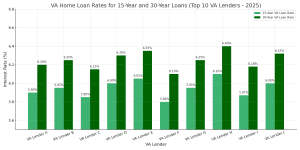
Like conventional mortgage rates, VA mortgage rates fluctuate with the market. They also depend on the repayment term you choose. VA approved lenders typically offer lower interest VA purchase rates for 15-year mortgages than for 30-year loans due to the shorter repayment period and reduced risk.
The VA loan rate you qualify for can be either fixed or adjustable. With a fixed interest rate, you’re guaranteed the same rate for the duration of your VA backed loan. A variable interest rate mortgage will have a fixed rate for an initial period, after which it will adjust periodically based on market conditions.
VA mortgage rates, like all consumer borrowing rates, have risen in recent years following a series of interest rate hikes by the Federal Reserve the last few years. While the Federal Reserve does not directly set mortgage interest rates, its policies significantly influence borrowing costs.
Overview of VA Home Loan Guidelines
Here are some of the key things to know about VA home financing in 2026:
- No down payment needed: For most Americans, no down payment home loans are a thing of the past. The closest most people can get is a 3.5% down-payment issued via FHA loan guidelines. But if you can qualify for a VA loan, it usually can be with no money down. Qualified VA borrowers love the $0 down home loans. All you need to pay is closing costs and the VA funding fee. Borrowers love the no down payment requirement with the VA backed zero down purchase loans.
- No mortgage insurance: If you qualify for the VA loan benefit, you do not have to pay for mortgage insurance or PMI. This is usually required for people who have less than 20% stake in the property. PMI will typically add $100 or more to your monthly payment.
- Flexible lending requirements: Many other lenders have higher credit standards than a decade ago. But the VA mortgage is a military benefit, so the standards are quite flexible. As long as you have a credit score of 620 or higher, you should be able to qualify for the VA home loan benefit.
- Low interest VA loan rates: VA mortgages are usually lower than market rates, so you should be able to have one of the lowest possible monthly payments.
- No pre-payment penalties: If you want to pay off the purchase loans early or refinance, you will not be penalized.
VA Home Loan Requirements
You are eligible for VA loan terms if you meet one of the following criteria:
- Completed at least 90 days of active duty service.
- Served at least six years in the Reserves or National Guard.
- Completed at least 181 days of active duty service during peacetime.
- Accumulated 90 days of cumulative service under Title 10 or Title 32, with at least 30 consecutive days for Title 32 service.
You can initiate a VA loan application through a bank, mortgage company, or credit union that provides such services. The VA home loan application process resembles that of other mortgage types: you provide employment, income, and financial details, and the lender evaluates your eligibility.
How to Get a Pre-Approval for a VA Home Loan
An essential requirement is obtaining a VA certificate of eligibility, a document issued by the Department of Veterans Affairs verifying your fulfillment of the service prerequisites for a VA loan. You can acquire this document directly from the VA or request a VA mortgage lender to obtain it on your behalf.
Once you have shown a lender your income, tax and payroll documentation, he or she can give you a pre-approval letter. This letter is usually needed when you are going to look at homes and need the lender to state that you are pre-approved for purchase loans that are VA guaranteed. The owner of the property wants to see that you have the ability to get a home loan.
The VA pre-approval letter will usually say that you have been pre-approved for a VA loan up to a certain amount. You will still need to fully qualify for the VA loan eligibility, but the pre-approval letter is a critical step.
Those are the most important features of buying a home guaranteed by the VA today. The VA loan requirements have not changed much of the last few years. Now let’s examine what you need to qualify.
VA Loan Limits 2026 — Baseline and Ceiling (Partial Entitlement Only)
| Property Type | Units | Baseline Limit Most U.S. counties |
High-Cost Ceiling Designated high-cost counties |
|---|---|---|---|
| Single-Family Home | 1 unit | $832,750 | $1,249,125 |
| Duplex | 2 units | $1,066,250 | $1,599,375 |
| Triplex | 3 units | $1,288,800 | $1,933,200 |
| Fourplex | 4 units | $1,601,750 | $2,402,625 |
Alaska, Hawaii, Guam, and the U.S. Virgin Islands
Special statutory provisions set different limits in these areas. For one-unit properties, the baseline is $1,249,125 and the ceiling is $1,873,675.
Loan limits per the FHFA 2026 conforming loan limit announcement, effective January 1, 2026. The 2026 baseline rose $26,250 from $806,500 in 2025, a 3.26% increase reflecting average U.S. home price growth between the third quarters of 2024 and 2025. The high-cost ceiling is set at 150% of the baseline. The VA does not set its own loan limits — VA limits match FHFA conforming limits county by county. Borrowers with full entitlement have no loan limit at all and can borrow above these figures with zero down, subject to lender approval and appraised value. These limits apply only to borrowers with partial entitlement. Verify your specific county at fhfa.gov or with a VA-approved lender. Updated July 29, 2026.
High-Cost County VA Loan Limits — 2026
First, the question that matters most: do county limits apply to you at all? If you have full VA entitlement, they don’t. There is no VA loan limit, and you can buy at any price with zero down, subject to lender approval and appraised value. County limits apply only to partial entitlement — an active VA loan on another property, a prior VA foreclosure, or entitlement not yet restored.
| Limit Type | 1-Unit Amount | Where It Applies |
|---|---|---|
| National baseline | $832,750 | Roughly 95% of U.S. counties |
| National high-cost ceiling | $1,249,125 | Approximately 100 designated high-cost counties — 150% of the baseline |
| Between baseline and ceiling | Varies by county | Counties where 115% of the local median home value exceeds the baseline but falls short of the ceiling |
| Alaska, Hawaii, Guam, U.S. Virgin Islands | $1,249,125 baseline $1,873,675 ceiling |
Special statutory provisions — these areas do not follow mainland limits |
Counties at the $1,249,125 ceiling
The highest-cost markets in the country reach the national ceiling. These include the San Francisco Bay Area (San Francisco, San Mateo, Marin, Santa Clara, Alameda, Contra Costa counties), Los Angeles and Orange counties, the Washington D.C. metro (D.C. proper, Arlington, Alexandria, Fairfax, Montgomery, Loudoun), the New York City metro (the five boroughs, Westchester, Nassau, Suffolk), Nantucket and Dukes counties in Massachusetts, and Colorado mountain resort counties including Eagle, Pitkin, Summit, and San Miguel.
Counties above the baseline but below the ceiling
Many strong markets fall between the two figures, including San Diego County, King County, Washington (Seattle), Boulder County, Colorado, Suffolk and Middlesex counties in Massachusetts, and much of coastal Oregon and Washington. These county-specific limits are recalculated annually from local median home values and cannot be estimated from the national increase.
Look up your exact county. FHFA publishes the complete list of county limits for all 1- to 4-unit properties: FHFA Conforming Loan Limit Values Map. Your VA-approved lender can also confirm it in a single call.
VA loan limits match FHFA 2026 conforming loan limits county by county, effective January 1, 2026. The 2026 baseline of $832,750 rose $26,250 from 2025, a 3.26% increase reflecting average U.S. home price growth between the third quarters of 2024 and 2025. The VA does not set its own loan limits, and borrowers with full entitlement have no loan limit at all. Updated July 29, 2026.
How to Calculate Your Zero-Down Limit (Partial Entitlement)
If you have partial entitlement, use this four-step formula your lender will apply:
- Find your county’s 2026 one-unit conforming limit (from the table above or FHFA.gov)
- Multiply by 25% = maximum VA guaranty for your county
- Subtract entitlement already used (shown on your Certificate of Eligibility) = remaining bonus entitlement
- Multiply remaining entitlement by 4 = your approximate zero-down purchase ceiling
Example: Your county limit is $832,750. You have $50,000 of entitlement tied to an existing VA loan. Maximum guaranty: $832,750 × 25% = $208,187. Remaining: $208,187 − $50,000 = $158,187. Zero-down ceiling: $158,187 × 4 = ~$632,748. Anything above that requires a 25% down payment on the excess amount.
If you want to buy above your zero-down ceiling, a down payment is not necessarily prohibitive — you only put down 25% on the amount exceeding your remaining entitlement, not 25% of the total purchase price. A VA lender can run this calculation in minutes once they pull your COE.
What Are VA Loan Rates Today?
VA purchase and refinance rates track the broader mortgage market, moving with the 10-year Treasury yield and Federal Reserve policy. The Fed held its benchmark unchanged at 3.50%–3.75% on June 17, 2026 — its fourth consecutive hold — and its June projections show more participants forecasting an increase than a cut.
The VA rate advantage has widened considerably in 2026. Curinos data for July puts the average 30-year VA purchase rate at 5.83% against 6.87% for a conventional 30-year fixed — a gap of more than a full percentage point, and the lowest average among standard 30-year mortgage types. Other surveys show a narrower spread; Bankrate’s July 30 figures put the 30-year VA average at 6.50% against roughly 6.70% conventional. Read the range as 0.25 to 1.00 percentage points below conventional, depending on lender, points paid, and borrower profile.
Current VA Rates by Loan Type
| Loan Product | Approx. Rate July 2026 |
vs. Conventional | Notes |
|---|---|---|---|
| 30-year fixed VA purchase | 5.75% – 6.50% | 0.25% – 1.00% lower | No monthly mortgage insurance; zero down available; funding fee applies |
| 15-year fixed VA purchase | 5.25% – 5.75% | 0.25% – 0.75% lower | Higher payment; faster equity build; substantially lower total interest |
| VA IRRRL (streamline refi) | 5.83% – 6.26% | Best refinance pricing available | 0.50% funding fee; no appraisal or credit check required in most cases |
| VA cash-out refinance | 6.00% – 6.75% | Below conventional cash-out | Up to 90% LTV; funding fee 2.15% first use / 3.30% subsequent |
| VA jumbo above $832,750 |
6.25% – 6.90% | Varies by lender | Full-entitlement borrowers: zero down; lender overlays and reserve requirements apply |
Note the difference between rate and APR. The figures above are note rates. APR includes the funding fee, origination charges, and points — Navy Federal, for example, quotes 5.875% interest at 6.314% APR because the quote includes a 1.00% origination fee and discount points. Always compare APR to APR across lenders, and rate to rate.
The Bigger Advantage Isn’t the Rate — It’s the Missing Mortgage Insurance
The VA loan’s most powerful cost advantage is the elimination of monthly mortgage insurance. On a $400,000 purchase with 5% down, a conventional borrower pays roughly $150 to $250 per month in PMI until reaching 20% equity. A VA borrower pays nothing monthly, even with zero down.
Over five years that difference totals $9,000 to $15,000 — far exceeding the one-time funding fee in most scenarios. And veterans with a service-connected disability rating are exempt from the funding fee entirely, which on a $400,000 zero-down purchase saves an additional $8,600.
Please note that VA mortgage rates change daily. Consult VA-approved lenders directly to obtain a personalized rate based on your credit profile, loan amount, entitlement status, and whether you pay discount points.
Rate ranges reflect well-qualified borrowers with full entitlement. Sources: Veterans United (July 30, 2026 — 30-year fixed VA purchase 5.875%, 15-year 5.500%); Bankrate national VA survey (July 30, 2026 — 30-year VA 6.50%, VA refinance 6.26%); Curinos via Experian (July 2026 — VA purchase 5.83%, conventional 30-year 6.87%, assuming 720 FICO and a $350,000 loan); Navy Federal rate sheet effective July 30, 2026 (5.875% interest / 6.314% APR, including 1.00% origination fee and discount points). Rates change daily — always request a same-day Loan Estimate. Updated July 29, 2026.
VA Funding Fee 2026: Complete Rate Table
The VA funding fee is a one-time charge paid at closing on most VA-backed loans. It keeps the VA loan program self-sustaining without requiring taxpayer subsidies — which is what allows the VA to offer zero-down financing and no monthly mortgage insurance to future generations of veterans. The fee can be paid upfront at closing or rolled into the loan balance (the most common choice, adding it to your financed amount).
Current VA funding fee rates have been in effect since April 7, 2023, and are locked through November 14, 2031 per the Veterans Benefits Administration. Rates set by the U.S. Department of Veterans Affairs and confirmed by VA.gov.
Purchase and Construction Loans
| Down Payment | First Use of VA Benefit | Subsequent Use | Dollar Example on $350,000 Loan |
|---|---|---|---|
| 0% – 4.99% (No down payment) |
2.15% | 3.30% | $7,525 first use $11,550 subsequent |
| 5% – 9.99% | 1.50% | 1.50% | $5,250 (both) |
| 10% or more | 1.25% | 1.25% | $4,375 (both) — lowest available |
Refinance Loans
| Refinance Type | First Use | Subsequent Use | Notes |
|---|---|---|---|
| VA IRRRL (Streamline Refinance) | 0.50% | 0.50% | Lowest fee available; same rate regardless of prior VA loan use |
| Cash-Out Refinance | 2.15% | 3.30% | Down payment cannot reduce this fee; applies to full loan amount |
| Loan Assumption | 0.50% (all borrowers) | Paid by the borrower assuming the loan | |
VA Funding Fee Exemptions — Who Pays $0
The following borrowers are completely exempt from the VA funding fee and pay nothing:
| Exempt Borrower Category | Requirement | Estimated Savings on $350K Loan |
|---|---|---|
| Service-connected disability | Receiving VA disability compensation at any level (10%+), OR eligible for compensation but receiving military retirement pay instead | $7,525 – $11,550 |
| Purple Heart recipients | Active-duty service members who have received the Purple Heart and can provide evidence before closing | $7,525 – $11,550 |
| Surviving spouses (DIC) | Spouses of veterans who died in service or from a service-connected disability, receiving Dependency and Indemnity Compensation | $7,525 – $11,550 |
| Pre-discharge disability rating | Active-duty service members with a proposed or memorandum disability rating before closing | $7,525 – $11,550 |
Important: Approximately 6 million of the 18 million U.S. veterans receive VA disability compensation and qualify for a full exemption. If you have any service-connected disability rating, confirm your exempt status with your lender before closing — the fee cannot easily be removed after closing. Exemption status is verified through your Certificate of Eligibility (COE).
Strategic tip — the 5% threshold: If you are a subsequent-use borrower (using your VA benefit a second time or more) with no down payment, your fee jumps to 3.30%. Contributing just 5% drops that fee to 1.50%, saving $6,300 on a $350,000 loan. For subsequent-use borrowers with some savings, crossing the 5% threshold is often the highest-return financial move available at closing. Source: VA.gov funding fee and closing costs | NerdWallet VA funding fee analysis, 2026.
Top VA Mortgage Lenders in 2026
VA home loans, backed by the Department of Veterans Affairs, offer veterans and service members zero-down financing with competitive rates and no monthly mortgage insurance. The lenders below are among the largest and most active VA originators in 2026. Rates change daily — the figures shown are recent published quotes, not offers. Request a same-day Loan Estimate from at least three lenders before deciding.
| Lender | Headquarters | Recent Rate / APR | What Sets It Apart |
|---|---|---|---|
| Veterans United | Columbia, MO | 5.875% 30-yr fixed VA purchase, July 30, 2026 |
Largest VA lender by volume · free credit counseling for declined applicants · VA-exclusive focus |
| Navy Federal Credit Union | Vienna, VA | 5.875% / 6.314% APR Effective July 30, 2026; includes 1% origination and points |
Military-focused · proprietary Military Choice loan · membership limited to military and family |
| United Wholesale Mortgage | Pontiac, MI | Verify current | Broker channel only — you access it through a mortgage broker, not directly |
| Freedom Mortgage | Mount Laurel, NJ | Verify current | High VA volume · rate-alert monitoring for future refinance opportunities |
| loanDepot | Lake Forest, CA | Verify current | Digital application · fast average closing times |
| New American Funding | Tustin, CA | Verify current | NAF Cash all-cash offer program · focus on underserved borrowers · flexible credit |
| Guild Mortgage | San Diego, CA | Verify current | Accepts non-traditional credit history · lower credit overlays than most |
| DHI Mortgage | Austin, TX | Verify current | Affiliated with D.R. Horton — best fit if buying that builder’s inventory |
| Village Capital & Investment | Henderson, NV | Verify current | VA and FHA refinance specialist · high IRRRL volume |
| PenFed Credit Union | McLean, VA | Verify current | Membership open to the general public — no military affiliation required |
| Flagstar Bank | Troy, MI | Verify current | Bank-based VA lending with branch access · first-responder programs |
What All VA Lenders Have in Common
Every lender above offers VA purchase and refinance loans and requires a Certificate of Eligibility. Beyond that, the differences matter more than the similarities:
- The VA sets no minimum credit score. Every score requirement you encounter is a lender overlay, commonly 580 to 620 — which is why the same file gets approved by one lender and declined by another. See our guide to low credit score VA home loans.
- Closing costs run 1% to 3% of the loan amount — roughly $2,000 to $6,000 on a $200,000 loan.
- The funding fee is 2.15% on a first-use zero-down purchase and 3.30% on subsequent use. It can be financed into the loan, and it is waived entirely for veterans with a service-connected disability rating — worth $8,600 on a $400,000 purchase.
- Rate quotes are not comparable unless you compare APR to APR. Navy Federal’s published 5.875% carries a 6.314% APR because the quote includes a 1.00% origination fee and discount points. A lower rate with points can cost more than a higher rate without them.
VA mortgage rates shown are recent published quotes from lender disclosures and change daily. Veterans United rate as of July 30, 2026; Navy Federal effective July 30, 2026. Entries marked “verify” should be confirmed against each lender’s current rate page before relying on them. Market share and volume rankings vary by source and reporting period. Updated July 29, 2026.
Military Service Requirements for VA Loans
You have to be eligible for a VA loan option to get one. Active military and veterans must mean certain qualification standards regarding their service. The current standards to qualify from a service perspective are:
- Serve at least 90 consecutive days active during wartime
- Serve at least 181 consecutive days during peacetime
- Serve at least 6 years for the National Guard or Reserves
- Be the surviving military spouse for those who died in the line of duty or with a service-related, major disability
At least one of the aforementioned service requirements must be satisfied. In the event that they are not met, an alternative avenue to eligibility is to be the spouse of a military member who either lost their life in the line of duty or due to a service-related disability.
Typically, remarriage is not allowed. If you meet some or all of these requirements, you qualify for a VA home loan from a service perspective. You will still need to qualify financially, however.
Note: A co-borrower on the VA loan eligibility must also be a veteran or the spouse of the primary borrower who meets the criteria. Don’t forget that VA loan requirements can change so verify you and your co-borrower still meet the criteria.
Credit for VA Home Loan Qualification
 VA loans are very flexible in terms of qualifying, but you will still need to have acceptable credit to get a VA-house loan.
Here are some of the common things you will need to answer with your lender:
- Credit score: As long as it is 620 or higher, you should be able to qualify with most VA mortgage companies.
- If you are lower than that, you may have problems. Ask the lender to check with all three credit bureaus and try to get a score at or above 620. However some VA approved lenders will offer VA loans for bad credit as long as the borrower meets the other VA guidelines.
- Collections or judgments: If you have past due accounts or accounts that have gone into collection, you may have problems getting a VA loan until those are resolved.
- Foreclosures or bankruptcies: If you have a bankruptcy or foreclosure, you will usually need to wait at least a year before being approved for VA loans to buy a home.
- Current income: Is your income stable and can you afford the monthly payment? Even though most veterans can get the VA home loan benefit, the lender must ensure that you have the ability to pay the loan.
What Are VA Home Loan Amounts?
How much home you can buy with a VA loan depends upon your income and debts, but most lenders currently cap VA loans at $417,000. Higher than that and VA will not pay back the lender in case you default. The VA loan limit is higher than FHA and conventional mortgages in most cases.
What Are Closing Costs on VA Loans?
All mortgages have closing costs. VA purchase loans still have lending fees and closing costs. These VA closing costs can range from 1 to 5% of your loan amount. However, the seller is allowed to cover up to 4% of the home’s purchase price in closing costs.
The typical VA loan costs are: appraisal, title charges, VA funding fee, and possibly discount points. Also, you may need to pay a credit report fee. Shop for the Best VA Mortgage Lenders offering competitive VA House Loans for people in the Air Force, Army, Navy, Marines, Coast Guards, Reserves, etc.

The VA home loan is a great finance vehicle for those who have previous military service.
It is really the premium finance choice if you qualify for the government endorsed program.
The reason is that the VA loan benefits and qualification criteria are so generous.
What Are VA Loan Benefits:
Numerous advantages accompany the VA loan benefit, a program meticulously crafted to recognize and support our nation’s servicemembers. The VA guarantees zero down home loans for first time buyers. Some of these VA loan benefits encompass:
- Reduced VA loan rates
- zero down payment requirement
- No PMI (private mortgage insurance)
- Access to VA cash out refinance program
- Higher debt-to-income ratio allowances
- Assistance with closing costs, with the potential for seller concessions of up to 4% of the purchase price, which your real estate agent can skillfully negotiate
- No early repayment penalty fees
If you have a desire to buy a home using a VA loan benefit, we will help you find an experienced VA lender. We comprehend the distinct needs of servicemembers and their families and can guide you in seizing the VA loan benefits you’ve rightfully earned.
FAQ for VA Home Loans
Who qualifies for a VA loan?
Eligibility for a VA loan option is available to veterans, active-duty service members, reservists, and surviving spouses. To qualify, applicants must meet specific service requirements set by the Department of Veterans Affairs and obtain a Certificate of Eligibility (COE), which verifies their eligibility status. The COE can be acquired through the VA’s eBenefits portal, a lender, or by mail, ensuring applicants meet the necessary conditions to access this home loan benefit.
How do I apply for a VA loan?
You can apply for a VA loan through VA-approved lenders by submitting your Certificate of Eligibility (COE) along with the necessary financial documents, such as income statements and credit information. Many VA lenders use the Web LGY system to streamline the process, allowing them to quickly obtain COEs on behalf of borrowers, reducing delays and simplifying the application process on VA loans. (VA.gov, 2026)
What credit score do I need for a VA loan?
The VA does not set a minimum credit score requirement, but most lenders prefer a score of at least 620. Individual lenders may have stricter requirements depending on loan terms and borrower history. Keep in mind that there is actually no minimum credit score for VA loans, so if you have below average credit and are eligible for a VA loan, you need to find the right lender.
Can I Get a VA Loan with a Manufactured or Mobile Home?
Many military borrowers want to know if they can get a VA home loan for mobile home. Yes and know. If you have a mobile home that was converted to a manufactured house and meets the VA specifications it is possible. Many borrowers have gotten a VA loan manufactured home financing. Make sure when you are shopping VA home lenders that you verify they do VA loans on manufactured or modular homes.
Do you have to be active duty to get a VA loan?
No, active-duty status is not mandatory to qualify for a VA loan. Veterans, certain National Guard and Reserve members, and some surviving spouses may also be eligible, provided they meet specific service and discharge criteria. Obtaining a Certificate of Eligibility (COE) is essential to confirm qualification.
What are the occupancy requirements for a VA loan?
Borrowers are generally required to occupy the home as their primary residence within 60 days of closing. However, exceptions may be made for service members on active duty, allowing them additional flexibility if deployment or other military obligations prevent immediate occupancy. In such cases, a spouse or dependent may fulfill the occupancy requirement on the borrower’s behalf.
Can I use a VA loan to purchase an investment property?
VA loans are intended for primary residences only. However, buyers can purchase multi-unit properties (up to four units) if they occupy one as their primary home (Military.com, 2025)
What is a VA Streamline Refinance?
Can I get a National Guard VA loan?
Yes, National Guard members may qualify for a VA home loan. Eligibility typically requires at least six years of service in the Guard, or 90 days of cumulative active-duty service under Title 32 orders, with at least 30 consecutive days. A Certificate of Eligibility (COE) is necessary to proceed.
Can a non-veteran assume a VA loan?
Yes, a non-veteran can assume a VA loan if the original loan was closed before March 1, 1988, or if the lender and VA approve the assumption. The new borrower must meet credit and income requirements. However, the veteran’s VA entitlement remains tied to the loan unless the buyer is a qualified veteran who substitutes their entitlement.
What is a 100 percent disabled veteran home loan?
A 100 percent disabled veteran home loan refers to a VA-backed mortgage with enhanced benefits for veterans rated totally disabled. These include exemption from the VA funding fee, eligibility for property tax exemptions in many states, and access to VA zero-down payment financing. It provides more affordable homeownership options for qualifying disabled veterans.
What is the VA funding fee?
The VA funding fee helps sustain the VA loan program and varies based on loan type and borrower status. First-time users pay 2.15% to 3.3%, while subsequent users may pay a higher interest rate.
Can I use a VA loan more than once?
Yes, you can use a VA loan multiple times as long as you meet the eligibility requirements for each new loan. However, only one active VA loan is typically allowed at a time, unless you qualify for a second entitlement. This second entitlement can enable you to take out another VA loan while still holding an existing one, often used when relocating or purchasing a second home due to a change in duty station or family needs. As long as the loan remains within the VA loan guidelines, you can access this benefit repeatedly throughout your lifetime.
Can you have two VA loans at the same time?
Yes, it’s possible to have two VA loans simultaneously under certain conditions. This often occurs when a veteran relocates but wants to keep the first home. The second loan depends on remaining VA entitlement and meeting occupancy and lender guidelines.
How long does it take to assume a VA loan?
Assuming a VA loan typically takes 30 to 60 days, depending on the lender’s processing time and the buyer’s eligibility. The process involves credit approval, VA forms, and legal paperwork. Once approved, the new borrower assumes the loan’s current balance, interest rate, and terms.
Can you use a VA loan to buy land?
VA loans generally do not cover the purchase of raw land alone. However, they can be used to buy land if it’s combined with a construction loan for building a primary residence. The land and home must meet VA property standards and be intended for owner-occupancy.
Do I need PMI with a VA loan?
No, VA loans do not require private mortgage insurance (PMI), regardless of the down payment. Instead, borrowers pay a one-time VA funding fee, which helps support the program. This benefit can significantly lower monthly mortgage payments compared to conventional loans.
How long do you have to serve in the military to get a VA loan?
Service requirements for a VA loan vary:
- Active-duty members: At least 90 continuous days during wartime or 181 days during peacetime.
- National Guard and Reserve members: Six years of service, or 90 days of cumulative active-duty service under Title 32 orders, with at least 30 consecutive days. These requirements may differ based on service dates and discharge status.


The Bottom Line on VA Home Loan Financing
A VA home loan is one of the best benefits today of military service once you get home. You can get a loan with no money down, no mortgage insurance and a very low interest rate. It also is easy to qualify for a VA home loan.
If you are a military vet or current military, you should see if you can qualify for a VA loan before you consider any other mortgage product.
Disclosure: RefiGuide.org is an advertising marketplace, not a licensed mortgage lender or broker. VA loans are matched with participating NMLS-licensed institutions that are approved for VA mortgages.
Sources:
-
- Federal Housing Finance Agency. (2025, November). FHFA announces conforming loan limit values for 2026.
Reviewed by: Bryan Dornan, Lending Expert (25+ years) | Fact Checked ✓
About Bryan Dornan
Bryan Dornan is a financial journalist and mortgage industry veteran with nearly 30 years of experience as a lender, loan officer, mortgage broker, and chief marketing officer. He currently serves as Chief Editor of RefiGuide.org, where he has built one of the most trusted mortgage education platforms in the United States. Bryan has founded multiple mortgage and digital marketing companies throughout his career and remains focused on helping homeowners leverage home equity wisely while making affordable homeownership accessible to everyday Americans. He is a licensed California Real Estate Broker DRE: #01203791. and writes for RealtyTimes, Patch, Buzzfeed, Medium and other national publications. Find him on Twitter, Muckrack, and Linkedin
More articles by Bryan Dornan