


Smart homeowners in California continue turning to the best HELOC lenders online for good reason. American mortgage holders collectively hold roughly $11 trillion in tappable home equity according to ICE Mortgage Technology, and the Golden State accounts for the largest concentration of any state making home equity lines of credit an attractive vehicle for financing home improvements, consolidating high-rate credit card debt, funding education, or acquiring investment property.
Top California HELOC Lenders 2026
| Lender | Starting APR | Max CLTV · Line · Fees | Best For |
|---|---|---|---|
| West Capital Lending ★ | Quoted individually and | Speed — approval in minutes, funding in as few as 5 days. Direct lender and broker | |
| Figure Lending ★ | 6.50%–15.50% | 85% of value | Funds in about 5 days; loans under $400K usually skip the in-home appraisal |
| Navy Federal CU ★ | Rate match – | 95% CLTV ★ | Military and DoD employees — highest CLTV plus a 20-year draw period |
| Bank of America ★ | Prime-indexed- | 85% CLTV | Existing customers wanting jumbo capacity — highest ceiling on this list |
| Golden 1 Credit Union ★ | Prime + margin | 80% CLTV | Owner-occupied, vacation and investment properties — rare coverage in CA |
| Wescom Credit Union ★ | Intro rate | 90% CLTV | SoCal homeowners wanting a low intro rate plus mid-draw fixed conversion |
| SchoolsFirst FCU ★ | Prime + margin | 80–90% CLTV | CA school employees, retirees and family · 70+ branches statewide |
| loanDepot ★ | 7.21%–7.85% | 85% CLTV | Existing loanDepot customers · branches across LA, OC, SD and the Bay Area |
| New American Funding ★ | Contact lender | 85% CLTV | Borrowers with higher DTI or lower credit declined elsewhere |
| Aven Financial ★ | 6.99%–15.49% | 89% LTV | Equity access via Visa card · approval in about 15 minutes |
The national average HELOC rate is 7.43% as of July 22, 2026, according to Bankrate’s survey of the nation’s largest home equity lenders — unchanged for three consecutive weeks and holding close to its 2026 highs. That average reflects a $30,000 line and a prime rate of 6.75%, steady since December 2025 after the Federal Reserve held its benchmark at 3.50%–3.75% for a fifth consecutive meeting on July 29, 2026. Verify NMLS numbers at nmlsconsumeraccess.org. Updated August 5, 2026.
The direction has shifted. July’s FOMC vote was 9–3, with all three dissenters favoring a rate increase — the first time since September 2016 that three policymakers dissented in the same direction. Markets now price two quarter-point hikes before year-end, which means California borrowers weighing a HELOC are choosing between today’s rate and a likely higher one.
Demand remains resilient despite elevated pricing. Curinos projects home equity originations will grow by up to 3% in the first half of 2026, driven by substantial untapped equity and homeowners locked into below-market first mortgages who won’t surrender them to a cash-out refinance.
California HELOC context. California follows federal HELOC guidelines without additional state-specific borrowing restrictions. But the state’s median home price reached $904,640 in June 2026 per the California Association of Realtors — with Orange County at $1.49 million and San Diego County at $1.085 million — which makes jumbo HELOC capacity essential rather than optional. California’s wildfire insurance situation also means some lenders now require additional documentation, and occasionally proof of bound coverage, on properties in CAL FIRE-designated high-risk zones.
One distinction to watch: “no closing costs” and “no fees” are not the same claim. Several fintech lenders waive third-party closing costs while charging origination or first-draw fees approaching 5%, alongside higher rates.
As of June 2026, California’s statewide median home price stood at $904,640, according to the California Association of Realtors — above the $900,000 mark for a third consecutive month, though down 2.8% from May’s record $930,260 and up just 0.4% from a year earlier. Values remain far higher in coastal markets: Orange County’s median reached $1.49 million and San Diego County’s $1.085 million. Prices are essentially flat statewide rather than climbing, which means Californians tapping equity today are drawing on appreciation already banked, not appreciation still accruing.
On the rate side, the Federal Reserve has now held its benchmark at 3.50%–3.75% for five consecutive meetings, most recently on July 29, 2026 — a 9–3 vote in which all three dissenters favored a rate increase, the first time since September 2016 that three policymakers dissented in the same direction. Prime remains anchored at 6.75%, unchanged since December. Bankrate’s national HELOC average sits at 7.43% as of July 22, 2026, unchanged for three consecutive weeks and holding near its 2026 highs. Markets now price two quarter-point hikes before year-end, which means the case for waiting has weakened considerably — California homeowners weighing a HELOC are choosing between today’s rate and a likely higher one, not a lower one.
What Makes the Best HELOC Lenders Special in California?

In California, where property taxes, insurance premiums and wildfire-related coverage costs inflate the total cost of ownership, securing a sub-7.5% HELOC means targeting credit unions and fintech lenders that leverage local advantages like no-appraisal HELOC options, automated valuation models, and member rate discounts.
A home equity line of credit functions as revolving credit secured by your home equity, typically allowing draws up to 80–90% combined loan-to-value during a 5- to 10-year draw period, followed by a repayment phase of 10 to 20 years. These variable rates are pegged to the prime rate — currently 6.75%, unchanged since December 2025, after the Federal Reserve held its benchmark at 3.50%–3.75% for a fifth consecutive meeting on July 29, 2026. That stability has now run roughly eight months, which is unusual — but it may be ending in the wrong direction.
Rates improved through early 2026, then stalled. Bankrate’s national HELOC average sits at 7.43% as of July 22, 2026, unchanged for three consecutive weeks, while Curinos data reported by Yahoo Finance puts top-tier pricing at 7.23%. ICE Mortgage Technology reported the average introductory rate on second-lien HELOCs fell to 6.6% in March 2026, the most attractive level since late 2022 — at that pricing, accessing $50,000 in equity costs roughly $275 monthly.
The direction has shifted, and it argues for acting rather than waiting. July’s FOMC vote was 9–3, with all three dissenters favoring a rate increase — the first time since September 2016 that three policymakers dissented in the same direction. Markets now price two quarter-point hikes before year-end. A California homeowner weighing a HELOC today is choosing between the current rate and a likely higher one.
For Californians specifically, high property values create both opportunity and complication. Loan amounts routinely exceed standard lender ceilings, making jumbo-capable lenders essential — U.S. Bank, for instance, extends home equity lending to $1 million in California, its highest limit in any state. Earthquake insurance requirements, condo project approval standards, and county-level recording fees also vary considerably between Southern California, the Bay Area and the Central Valley.
The RefiGuide published this article highlighting the five home equity lenders offering the lowest HELOC rates in California this month, drawn from Forbes Advisor, NerdWallet, and LendEDU comparisons. We’ll also explore four case studies of Golden State homeowners who locked in top deals, plus lists of the top 10 California-headquartered lenders for HELOCs and the top five in Orange County.
The timing argument is stronger than it was in the fall — for a different reason than before. ICE’s June 2026 Mortgage Monitor found homeowners tapped equity at the highest first-quarter levels since 2021, with second-lien lending reaching its strongest first-quarter volume in nearly two decades. Roughly 248,000 second-lien borrowers withdrew $25 billion in Q1 2026, and nearly two-thirds of those originations came from homeowners who took first mortgages between 2020 and 2022 — borrowers protecting below-market first-lien rates rather than surrendering them to a cash-out refinance. About $11 trillion in tappable equity remains nationally. With the Fed’s own committee split toward tightening, locking a competitive margin over prime is a bet on stability rather than a bet on further declines.
4 Case Studies: California Homeowners Comparing HELOC Lenders
The following are illustrative examples based on typical file structures in California markets. They do not describe actual borrowers. Figures demonstrate how the math works; individual results vary by lender, market, credit profile, and property.
Case 1: Bay Area Educator Funds College Tuition
The borrower. A public school teacher in San Jose, age 48, with roughly $300,000 in equity in a 1980s tract home. Credit score 720, salary $95,000. She needed $80,000 for her daughter’s UC tuition.
| Lender | West Capital Lending (NMLS #1566096) |
|---|---|
| Structure | Fixed rate at origination, redraw feature |
| Line approved | $80,000 |
| Time to fund | Approval in minutes; funding within days |
| Payment structure | Interest-only minimum during draw |
Why this structure fit. Tuition arrives on a predictable schedule, so a fixed rate mattered more than draw flexibility. West Capital’s product funds the full amount at origination at a locked rate — which suits a known expense better than a revolving line whose payment moves with prime.
The comparison she ran. Private student loans for parent borrowers commonly price well above HELOC rates. On $80,000, the spread between a HELOC in the low 7s and a private education loan in the 9s exceeds $1,500 a year in interest.
The tradeoff. Student loans are unsecured. A HELOC is secured by the home — default risks foreclosure rather than collections.
Case 2: Orange County Retiree Adds an ADU
The borrower. A retired engineer in Irvine, age 62, with a $1.2 million mid-century home and a 750 credit score. He wanted $150,000 to build a solar-equipped accessory dwelling unit for rental income.
| Lender | Aven Financial (NMLS #2042345) |
|---|---|
| Max LTV | 89% |
| Rate type | Fixed for life of the line |
| Fee structure | 4.9% first-draw fee |
| Time to fund | Approval in ~15 minutes; funding in as few as 3 days |
Why fixed mattered here. He was funding construction against a fixed pension. A variable rate that reprices upward during a multi-month build creates budget risk a retiree on fixed income can’t absorb. With the Federal Reserve holding five consecutive meetings and three officials now voting for increases, that consideration carries more weight than it did a year ago.
Watch the fee. Aven’s 4.9% first-draw fee on $120,000 is roughly $5,880. That’s real money and should be compared against lenders charging $0 closing costs, even at a slightly higher rate.
Case 3: Central Valley Investor Scales a Portfolio
The borrower. A Fresno realtor, age 39, with commission income that varies month to month. Credit score 690. She owned a $450,000 primary residence and wanted $90,000 for a duplex down payment.
| Lender | Golden 1 Credit Union (NMLS #669333) |
|---|---|
| Max CLTV | 80% |
| Line range | $25,000–$500,000 |
| Rate structure | WSJ Prime + margin; 4% floor, 18% ceiling |
| Notable | Covers owner-occupied, vacation and investment properties |
Why a credit union worked. Variable commission income complicates conventional underwriting. Golden 1 is California-only and one of the few lenders in the state covering all three occupancy types — which matters for an investor who may want a line against the duplex later.
The credit effect. Drawing $90,000 raised her utilization substantially in the near term. Whether that hits her score depends on how the lender reports the account — some classify HELOCs as revolving, others as installment. Assume revolving until confirmed.
The caution. Using a HELOC on a primary residence to buy an investment property puts the home at risk for a business decision. That’s a defensible trade for an experienced investor with reserves; it is not one for a first-time buyer stretching to enter the market.
Case 4: San Diego Family Consolidates Credit Card Debt
The borrower. A San Diego homeowner, age 45, carrying $60,000 across credit cards at roughly 21%. Credit score 680, with about $250,000 in equity.
| Line approved | $70,000 |
|---|---|
| Cards retired | $60,000 |
| Card utilization | Roughly 90% → 0% |
| DTI | 48% → 32% |
| Monthly interest at 21% | ~$1,050 |
| Monthly interest near 7.4% | ~$370 |
The saving is real and calculable. Moving $60,000 from roughly 21% to the low-7s cuts monthly interest by about $680 — roughly $8,100 a year. Eliminating 90% card utilization typically produces a substantial credit score gain within two reporting cycles, since utilization accounts for about 30% of a FICO score.
The risk worth stating plainly. He converted unsecured debt into debt secured by his home. Credit card default damages credit; HELOC default can cost the house. The gain only holds if the cards stay at zero — borrowers who consolidate and then re-accumulate end up worse off, because the equity is gone.
What These Cases Have in Common
Three patterns run through all four:
- The product matched the purpose. Fixed structures for known expenses, revolving lines for staged needs. Rate came second.
- Credit preparation happened before shopping, not after. Every borrower entered with a score at or above 680.
- California-specific factors shaped the choice — high property values requiring jumbo capacity, credit union membership advantages, and occupancy flexibility that varies more here than in most states.
For borrowers whose credit falls below these ranges, see our guide to home equity loans with bad credit.
Top 5 Orange County Mortgage Companies Offering the Lowest HELOC Rates

Orange County has a legitimate claim to being the mortgage capital of the country. Irvine, Costa Mesa and Santa Ana have incubated an outsized share of the nation’s largest lenders for four decades, and that concentration still produces unusually competitive home equity pricing for local homeowners.
The county’s affluence sharpens the effect. Orange County’s median existing single-family home price reached $1.49 million in June 2026 according to the California Association of Realtors — up from $1.47 million a year earlier and roughly 65% above the $904,640 statewide median. Equity positions that large push most OC borrowers into jumbo HELOC territory, where lender selection matters far more than it does at $200,000.
Against a national HELOC average of 7.43% as of July 22, 2026 — unchanged for three consecutive weeks — and with prime anchored at 6.75% since December, here are five Orange County-based lenders worth pricing:
SchoolsFirst Federal Credit Union (Tustin) — The nation’s largest credit union serving educators, offering HELOCs with lines to $500,000 and 70+ California branches. Membership limited to school employees, retirees and their families. Prime-indexed; request a current quote.
loanDepot (Irvine) — Second-lien pricing of 7.21% APR on 10-year and 7.85% APR on 30-year terms, with amounts from $35,000 to $350,000, 85% CLTV, and a 0.25% autopay discount. Fast closings and branch access across LA, OC, SD and the Bay Area.
California Credit Union (Anaheim branch) — Member-owned, priced at a margin over prime, with strong affordability ratings and no-cost options on qualifying lines.
Eagle Community Credit Union (Lake Forest) — Orange County-focused with local underwriting and rate-match consideration. Membership open to residents of Orange, Los Angeles, Riverside and San Bernardino counties.
West Capital Lending (Irvine) — Non-QM and jumbo specialist (NMLS #1566096) serving investors and self-employed borrowers. Quotes individually rather than publishing rates; available HELOC APRs through its partner network have ranged from roughly 7.05% to 15.60%, so get terms in writing. Operates as both direct lender and broker across 47 states.
Local lenders frequently price 25 to 50 basis points inside statewide averages, largely because they underwrite Orange County collateral daily and price the risk more accurately than national desks.
Summary of California’s HELOC Landscape in 2026
California enters the second half of 2026 with rates stable — but the balance of risk has shifted. The Federal Reserve has held its benchmark at 3.50%–3.75% through five consecutive meetings, most recently on July 29, 2026, leaving prime at 6.75% since December. That vote was 9–3, with all three dissenters favoring a rate increase — the first time since September 2016 that three policymakers dissented in the same direction. Markets now price two quarter-point hikes before year-end.
Bankrate’s national HELOC average of 7.43% as of July 22 was unchanged for a third straight week and sits near its 2026 high. Meanwhile ICE Mortgage Technology reports the average introductory rate on second-lien HELOCs fell to 6.6% in March, the most attractive level since late 2022 — meaning the spread between advertised intro pricing and fully indexed rates is unusually wide, and reading the post-intro terms matters more than the headline.
Fintech pricing leads the market: Figure’s APRs range from 6.50% to 15.50% fixed for the life of the draw, and Aven’s from 6.99% to 15.49%, though both carry origination or first-draw fees near 5% that offset part of the rate advantage. Among California-headquartered lenders, Golden 1 covers owner-occupied, vacation and investment properties statewide at 80% CLTV on lines from $25,000 to $500,000, while Orange County institutions like SchoolsFirst pair no-fee structures with branch access.
Nationally, homeowners hold roughly $11 trillion in tappable equity, with California representing the largest state share. Q1 2026 saw the strongest first-quarter second-lien volume in nearly two decades, as borrowers holding 2020–2022 first mortgages chose to add a second lien rather than surrender their below-market rate to a cash-out refinance. With three FOMC members now voting to raise rates, waiting for a materially better HELOC rate is a bet against the Fed’s own committee. Compare offers across at least three lenders, weigh total cost rather than the advertised APR, and consult a licensed advisor before deploying equity.
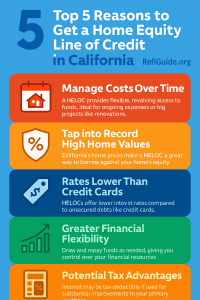
Why HELOCs Are So Popular in California in 2026
1. Substantial equity positions. California’s home values mean many owners hold enough equity to borrow meaningfully. The statewide median reached $904,640 in June 2026 per the California Association of Realtors, with Orange County at $1.49 million and San Diego County at $1.085 million.
2. Draw what you need, when you need it. A HELOC gives revolving access rather than a lump sum, and you pay interest only on the drawn balance — well suited to phased renovations or uncertain costs.
3. Far cheaper than unsecured credit. HELOCs average 7.43% nationally as of July 22, 2026, with strong-credit borrowers at 7.23%. Credit cards run 19% to 22%. On a $50,000 balance, that spread is roughly $500 a month in interest.
4. Interest may be deductible — but the rule is narrow. Deductibility applies only when proceeds buy, build, or substantially improve the home securing the loan, subject to the $750,000 combined debt cap. The Tax Cuts and Jobs Act eliminated it for other uses, and the One Big Beautiful Bill Act made that restriction permanent in July 2025. Debt consolidation, tuition, and investment purchases do not qualify. Consult a tax professional.
5. It preserves your first mortgage rate. Roughly half of mortgaged homeowners still hold a first mortgage below 4%. A HELOC accesses equity without repricing that balance — which a cash-out refinance at today’s rates would.
California HELOC Factors That Differ from National Averages
Wildfire insurance documentation. Some California lenders — particularly smaller banks and non-specialized national desks — have tightened HELOC approvals in high fire risk ZIP codes designated Tier 2 and Tier 3 by CAL FIRE. Credit unions that underwrite locally and hold their own loans, including Golden 1 and Wescom, tend to be more accommodating than national banks applying uniform standards. Confirm with each lender whether your ZIP code triggers additional documentation before applying — and in some cases, proof of bound coverage.
Jumbo capacity. At a $904,640 statewide median and $1.49 million in Orange County, standard $250,000–$400,000 HELOC caps may not reach meaningful equity on higher-value properties. Bank of America extends to $1,000,000, while Navy Federal reaches $500,000 at 95% CLTV — the highest CLTV on this list. Bay Area, LA, and Orange County borrowers should confirm the maximum credit line before applying, not after.
Credit union membership. Golden 1 is open to all Californians. Wescom serves Southern and Central California residents. SchoolsFirst is limited to California school employees, retirees, and their families. Navy Federal is limited to military members, veterans, DoD employees, and their families. BluPeak covers Alameda, Sacramento, San Diego, Santa Clara, and Yolo counties plus California state employees.
Comparing lenders, understanding total cost rather than the advertised APR, and matching the product to a defined purpose is what separates a strategic HELOC from an expensive one.
FAQs for California HELOC Lenders:
Can you get a HELOC in California if your home is in a wildfire risk zone?
Yes, though underwriting is tighter. Lenders typically require proof of bound hazard coverage before funding in CAL FIRE Tier 2 and Tier 3 zones, and some national banks decline these ZIP codes outright under uniform national underwriting standards. California credit unions that portfolio their own loans — Golden 1 and Wescom among them — generally show more flexibility. If your carrier non-renewed you and you now hold a FAIR Plan policy paired with a difference-in-conditions wrapper, expect to document both. Confirm ZIP-code requirements with each lender before applying rather than after.
What is the maximum HELOC amount you can get in California?
Ceilings vary widely. Bank of America extends HELOCs to $1 million, and U.S. Bank also lends up to $1 million in California — its highest limit in any state. Golden 1 and Navy Federal each cap at $500,000, while fintech lenders stop between $250,000 and $750,000. Your actual line depends on combined loan-to-value, not the ceiling. At 80% CLTV on a $1.49 million Orange County home carrying a $600,000 first mortgage, roughly $592,000 would be available. Review how much equity you need before applying.
Can you use a HELOC to build an ADU in California?
Yes, and it’s among the most common uses statewide since California streamlined accessory dwelling unit permitting. A HELOC fits ADU construction well because you draw in stages as contractors invoice, paying interest only on funds actually used rather than carrying a full lump sum from day one. Lenders underwrite against current appraised value, not projected post-construction value, so your existing equity cushion determines feasibility. Budget separately for permits, utility connections and impact fees, which vary sharply by city. See our second mortgage for home remodeling guide.
Is HELOC interest tax deductible for California homeowners?
Federal and state rules diverge here, which surprises many Californians. Federally, interest is deductible only when proceeds buy, build or substantially improve the home securing the loan, on combined mortgage balances up to $750,000. California has not conformed to that 2017 federal change, so for state returns the earlier rules generally still apply, permitting interest on home equity debt up to $100,000 regardless of how proceeds were used. Eligibility depends on your complete return, so confirm treatment with a California-licensed CPA before assuming a deduction. Always speak with a licensed tax advisor and very with the IRS.
Do California HELOC lenders require a full appraisal on high-value homes?
Often, yes. Automated valuation models perform well on tract housing but lose accuracy on the custom coastal and hillside properties common across California. Figure waives the in-home appraisal on most loans at or below $400,000, while jumbo requests above roughly $500,000 usually trigger a full interior appraisal costing $600 to $900 and adding one to two weeks. Ocean-view lots, architecturally unique homes and properties with thin comparable sales almost always require one. Factor that into your HELOC approval timeline.
Disclosures: RefiGuide.org is an advertising marketplace, not a licensed mortgage lender. Loans are matched with participating NMLS-licensed institutions.
NMLS numbers: Figure Lending LLC (#1717824); Aven Financial, Inc. (#2042345); Golden 1 Credit Union (#669333); Wescom Credit Union (#999430); Bank of America (#399802); Navy Federal Credit Union (#399807); loanDepot, LLC (#174457); New American Funding, LLC (#6606); West Capital Lending (#1566096, CA DRE #02022356); SchoolsFirst Federal Credit Union (#403009). Verify all NMLS registrations independently at nmlsconsumeraccess.org before applying.
Rate data: National average HELOC rate of 7.43% per Bankrate’s national survey of the largest home equity lenders, July 22, 2026 — unchanged for three consecutive weeks and based on a $30,000 line at 700 FICO and 80% CLTV. Strong-credit pricing of 7.23% per Curinos, July 2026.
Federal Reserve: Prime rate 6.75%, in effect since December 2025. The Federal Reserve held its benchmark at 3.50%–3.75% for a fifth consecutive meeting on July 29, 2026, on a 9–3 vote in which all three dissenters favored a rate increase.
California data: Statewide median existing single-family home price of $904,640, June 2026, per the California Association of Realtors.
All rates and terms are subject to change. Verify current rates, terms, and eligibility directly with each lender before applying. Last reviewed: August 5, 2026.
Reviewed by: Bryan Dornan, CA DRE: #01203791 | (25+ years) | Fact Checked ✓
About Bryan Dornan
Bryan Dornan is a financial journalist and mortgage industry veteran with nearly 30 years of experience as a lender, loan officer, mortgage broker, and chief marketing officer. He currently serves as Chief Editor of RefiGuide.org, where he has built one of the most trusted mortgage education platforms in the United States. Bryan has founded multiple mortgage and digital marketing companies throughout his career and remains focused on helping homeowners leverage home equity wisely while making affordable homeownership accessible to everyday Americans. He is a licensed California Real Estate Broker DRE: #01203791. and writes for RealtyTimes, Patch, Buzzfeed, Medium and other national publications. Find him on Twitter, Muckrack, and Linkedin
More articles by Bryan Dornan